


Grading protects trading cards from handling and gives collectors a consistent way to present valuable pieces. But there is a separate question worth asking before a graded collection goes on the wall: do PSA, BGS and CGC slabs actually block ultraviolet light?
For anyone researching PSA slab UV protection, whether graded cards fade in sunlight, or which acrylic to use for a graded trading card display frame, the answer depends on the exact holder and what its manufacturer has documented. A rigid, tamper-evident slab and a tested UV-filtering panel serve different purposes.
This guide focuses specifically on UV exposure and graded slabs. For the broader science behind acrylic, glass and wavelength filtration, see our complete UV protection guide for trading card display frames.
Are PSA, BGS and CGC slabs UV protected?
There is no single defensible UV-blocking percentage that can be assigned to every PSA, Beckett Grading Services (BGS) and CGC trading card holder. The manufacturers use different materials and holder designs, and holder generations can change over time.
A graded slab can protect a Pokémon, sports card, Magic: The Gathering or Yu-Gi-Oh! card from many everyday handling risks. That does not automatically establish how much UVA radiation passes through the clear front.
If a particular UV percentage matters to a collector, a published spectral transmission specification for that exact holder is more useful than a general claim that all graded cases are protective.
What a graded trading card slab is designed to do
PSA, BGS and CGC holders provide a rigid enclosure around an authenticated and graded card. Their construction helps reduce direct contact and creates a consistent form for storage, trading and display.
Those are substantial benefits, but they are not the same as a conservation glazing specification. UV filtration must be considered separately from physical protection, tamper resistance and optical clarity.
This matters especially when a collector moves graded slabs from a storage box to a bright wall display. The card has not changed, but its daily light exposure may have changed considerably.
What PSA has said about its newer holders
PSA introduced an updated holder for standard trading cards in 2024. In its announcement about the redesigned holder, the company described the new polymer as more resistant to UV damage from the sun, as well as more resistant to shattering and scratching.
That is a meaningful development. It should, however, be read as the statement PSA made about that holder material, not converted into a claim that every PSA trading card slab ever produced blocks 99% or 100% of ultraviolet radiation.
Older and newer slab generations should not be assumed to have identical properties. Nor should UV claims made for one PSA product category automatically be transferred to all standard trading card holders.
Can a PSA 10 card still fade in sunlight?
Yes. A high grade describes the assessed condition of the card at grading, not immunity from future exposure. In fact, PSA's reholder information expressly recognises fading caused by sunlight as an example of a possible change in a previously graded card's condition.
A PSA 10 Pokémon card, a graded sports rookie or a vintage TCG card can therefore deserve careful display placement even when the slab is in excellent physical condition.
Once printed colour has changed through light-driven deterioration, placing the card in darkness does not simply restore its original appearance.
What about BGS slab UV protection?
Beckett slabs provide rigid encapsulation and a distinctive grading label. Their presence in a display does not by itself establish a universal percentage of ultraviolet filtration.
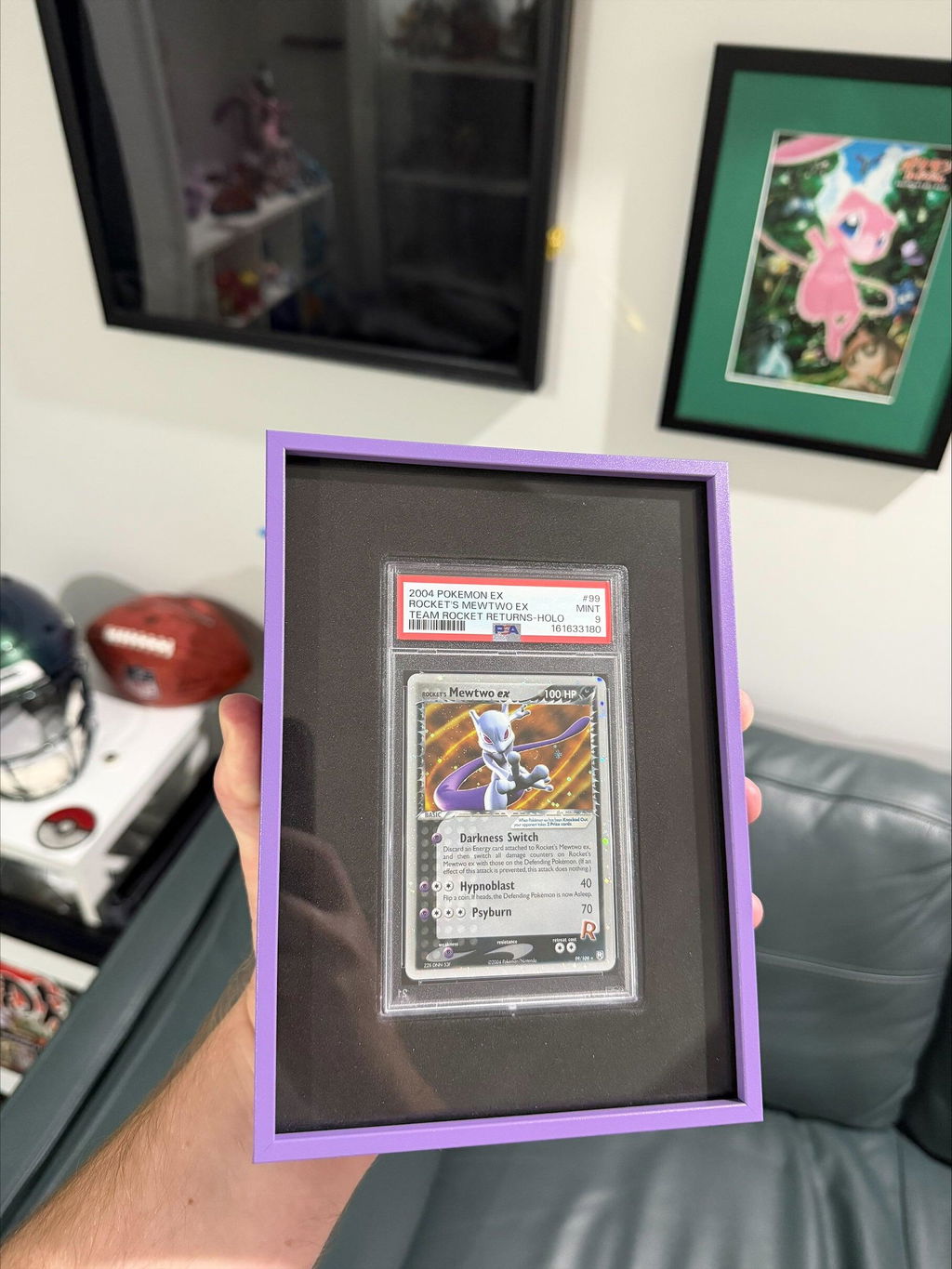
When evaluating a BGS graded card display frame, consider the slab as the protective holder and the outer acrylic or glass as a separately specified glazing layer. That allows a collector to choose frame materials based on documented UV performance without making assumptions about the slab itself.
This is equally relevant to BGS Black Label, Pristine and other graded collections.
Do CGC graded card holders filter UV?
CGC describes the clarity and protective construction of its graded card holders. As with PSA and BGS, that should not be converted into an unsupported numerical UV percentage.
Some grading labels use ultraviolet-reactive security features. A UV-visible authentication element is not the same thing as a claim that the entire holder blocks a particular proportion of incoming UVA or UVB radiation.
For a wall of CGC graded Pokémon, MTG or One Piece cards, external frame glazing can be selected independently of the encapsulation.
Why UV radiation matters when graded cards are displayed
Ultraviolet light is part of the radiation emitted by the sun. The UVA band extends towards 400 nanometres (nm), close to the visible-light spectrum. Materials that reduce shorter UV wavelengths do not necessarily block the whole UVA band.
Printed cards can contain inks, dyes, coatings, foils and other components with different light sensitivities. UV exposure can contribute to deterioration, but it is not the only factor. The Canadian Conservation Institute explains that visible light can contribute to fading even when UV filtration is used.
For that reason, the aim is to reduce unnecessary light exposure rather than assume that a slab or front panel makes direct sunlight harmless.
Does putting a PSA or BGS slab in a UV display frame help?
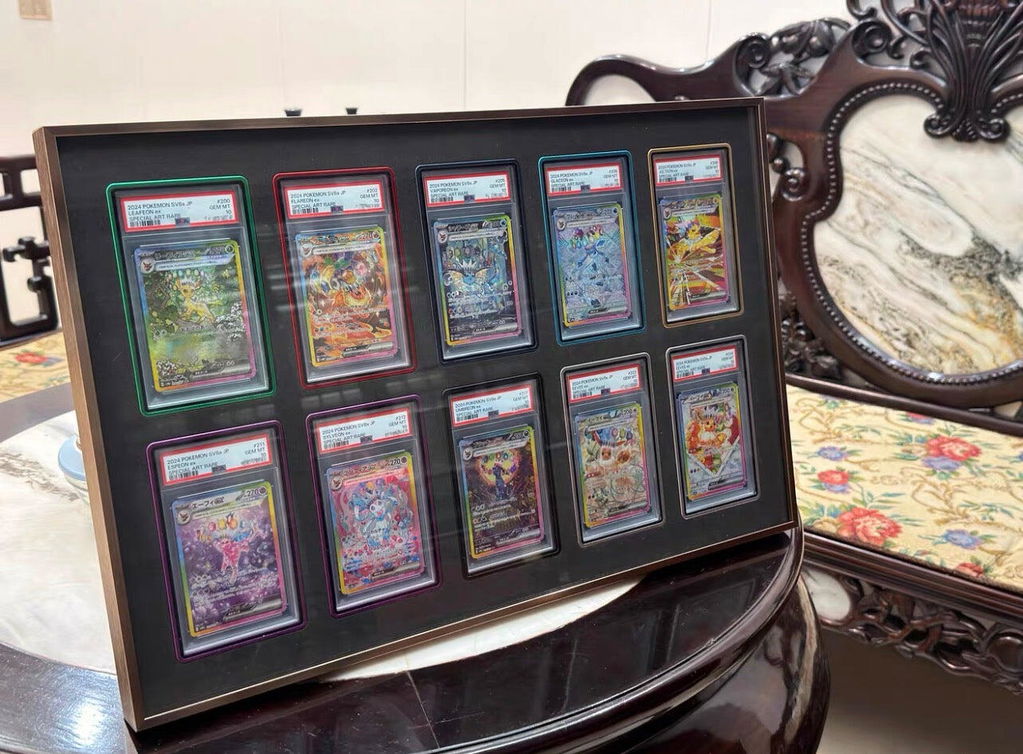
A display frame with documented UV-filtering acrylic or glass introduces an additional light-management layer in front of the slab. That can be useful whether the collection contains PSA, BGS, CGC or a mixture of graded holders.
The exact combined filtration depends on the spectral transmission of both the slab and the glazing. It is not technically correct to add two headline UV percentages together or claim complete protection without testing the combination.
For most collectors, the practical advantage is straightforward: the display frame can be chosen for its own specified acrylic or glass performance, while the grading holder continues doing its normal job.
Acrylic versus glass for graded slab display frames
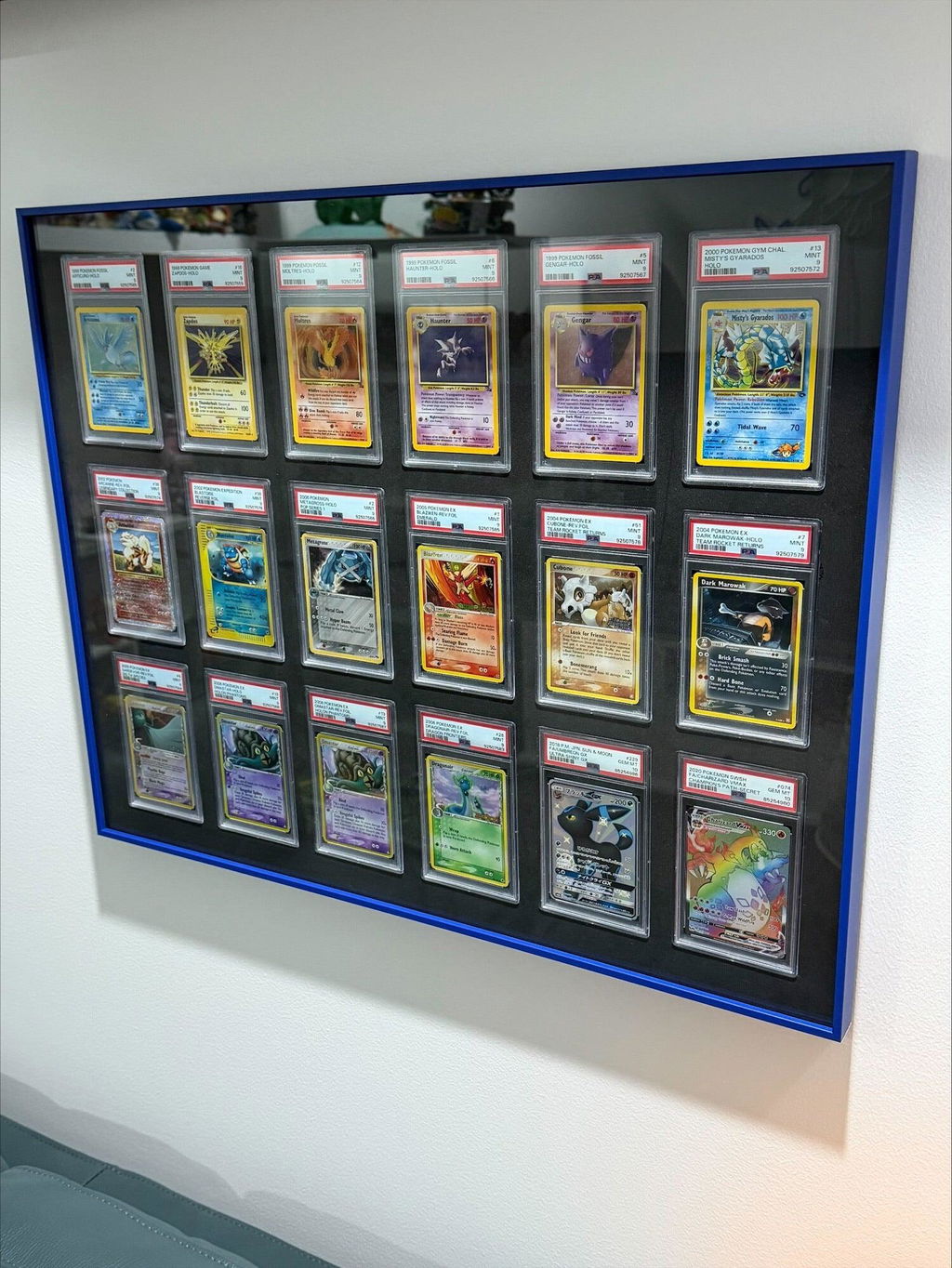
Acrylic is often preferred for large graded trading card wall displays because it is lighter than comparable glass and is generally more impact-resistant than ordinary glass. Those advantages become noticeable when a frame holds 20, 36, 54 or more slabs.
Glass is typically harder and more resistant to everyday scratching. Both acrylic and glass are available in specialist UV-filtering and anti-reflective grades.
The most useful comparison is between the actual products, including their UV transmission, reflectance, thickness and weight. For a complete material comparison, see our acrylic versus glass trading card display guide.
Standard UV-resistant acrylic and museum-grade glazing
Different acrylic formulations transmit different portions of the ultraviolet spectrum. A sheet described as UV-resistant may block shorter wavelengths strongly, while a specialist conservation sheet can be designed for broader filtering towards 400 nm.
A museum-grade anti-reflective material may also reduce distracting reflections from windows and room lights. This can be particularly attractive for graded slabs because the viewer looks through the outer frame glazing and the glossy slab surface.
Specialist glazing is an optional material choice. A quality clear front, sensible wall placement and controlled lighting can already produce an excellent graded display.
Sunlight through a window is still sunlight
A collection may be indoors and still receive strong daylight through a window. Ordinary window glass modifies the incoming UV spectrum, but it does not remove all relevant wavelengths or the intensity of visible light.
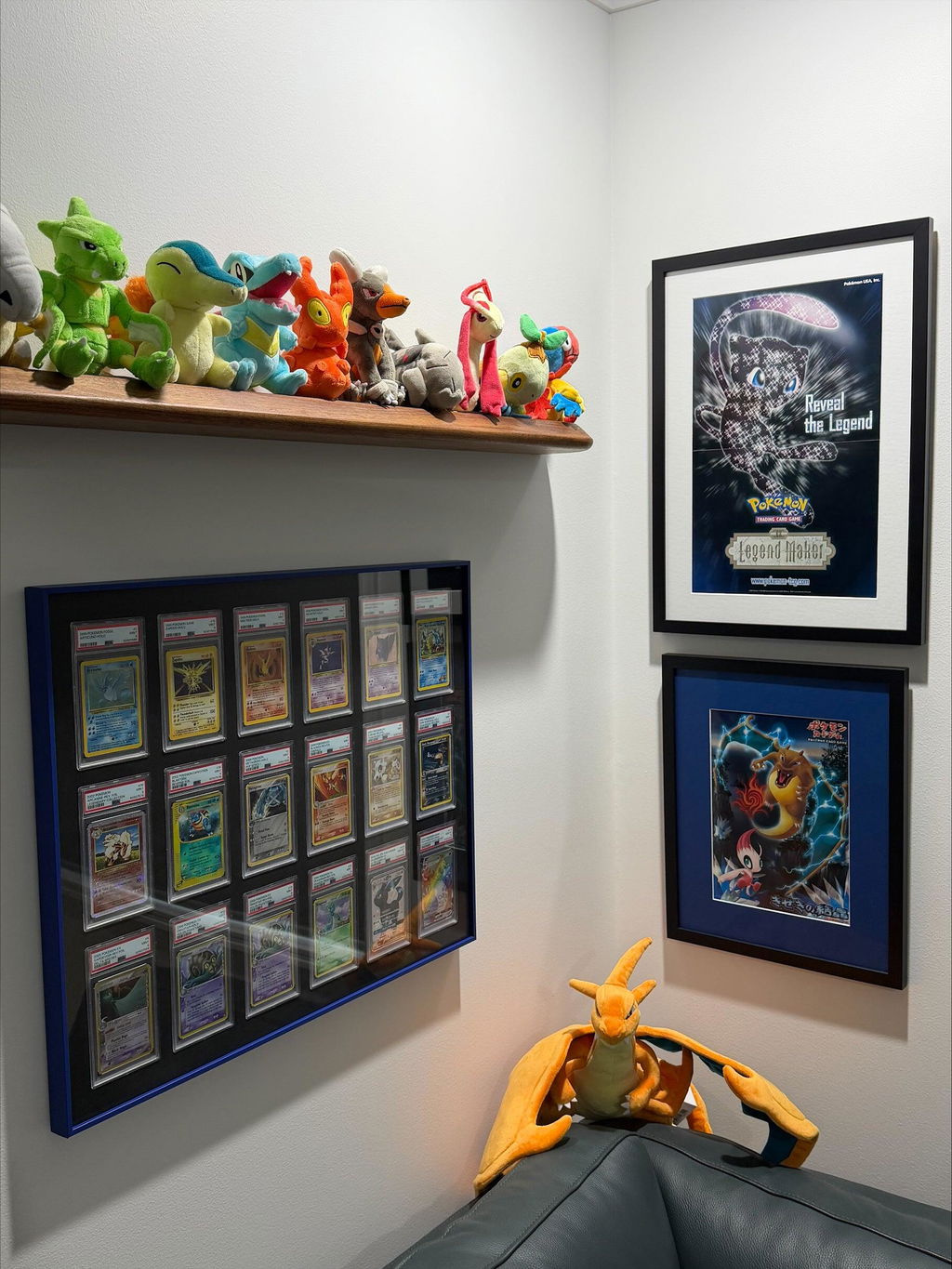
Before hanging valuable PSA, BGS or CGC cards, observe the chosen wall at different times of day. A spot that seems shaded in the morning may receive direct afternoon light. Seasonal changes can alter the pattern again.
Where practical, an interior wall outside direct sunlight is a more controlled starting point than a position directly opposite a bright window.
Do LED lights damage graded trading cards?
Many suitable LED lights produce relatively little UV, but they still emit visible light. Brightness and operating duration therefore matter when lighting a graded card display.
A second issue is reflection. A PSA, BGS or CGC slab adds another glossy surface behind the outer acrylic or glass, so a poorly placed LED strip can create glare at several levels.
Soft, directional lighting used only when needed often produces a cleaner visual result than leaving intense lighting on continuously. Our guide to LED lighting and trading card fading explores the subject in more detail.
Different trading card games, the same UV question
Pokémon, Yu-Gi-Oh!, One Piece, Disney Lorcana, Magic: The Gathering (MTG), Digimon and sports card collections may differ greatly in artwork, printing and holder choices. The basic light-management question remains the same: how much radiation reaches the card, and for how long?
There is no reason to assume that all cards in one TCG have identical fading resistance, or that a high grading score reveals an ink's UV sensitivity. Display decisions should consider the specific item, its holder and the room.
How to compare UV claims for graded card cases
| Claim or specification | What it tells you | What it does not establish |
|---|---|---|
| Rigid graded slab | The card has a physical protective holder | A fixed UV-filtration percentage |
| UV-resistant holder material | The material is engineered for some form of UV resistance | Complete UVA blocking without transmission data |
| UV-filtering display acrylic | The front panel can reduce specified UV wavelengths | Protection against all visible-light fading |
| Museum-grade anti-reflective glazing | Specialist UV and optical performance may be available | That direct sunlight becomes ideal for valuable cards |
Practical checklist for a graded card wall display
- Identify whether your collection uses PSA, BGS, CGC or mixed slab formats.
- Choose a wall that avoids regular direct sunlight.
- Compare the outer glazing by its actual UV wavelength data.
- Consider reflections through both the slab and frame front.
- Choose lighting that is controlled and does not create unnecessary heat.
- Confirm the mounting and frame construction are suitable for the number of slabs.
- Keep the display accessible if cards will be changed or upgraded later.
Frequently asked questions
Are PSA slabs 100% UV protected?
Do not assume a universal 100% UV-blocking rating for every PSA trading card slab. PSA has described improved UV resistance in its newer holder polymer, but the exact holder and its documentation matter.
Can a PSA 10 Pokémon card fade in a display frame?
Yes. A PSA 10 grade does not prevent future light-driven changes. Use suitable glazing and avoid prolonged direct sunlight.
Are BGS Black Label slabs UV protected?
The Black Label grade should not be confused with an optical filtration rating. Check material-specific UV information rather than inferring it from the label.
Are CGC slabs better than PSA for UV protection?
A reliable comparison would require equivalent wavelength transmission data for the particular holder generations. Do not infer a winner from grading-company names alone.
Does UV acrylic in front of a slab provide extra protection?
It can provide a separately specified filtering layer. The exact combined result depends on the properties of both materials.
Is glass better than acrylic for displaying graded cards?
Both can be excellent in the right grade. Acrylic offers lower weight and impact resistance, while glass generally resists scratches better.
Do graded cards need to be kept away from windows?
Keeping valued graded cards outside direct sunlight is sensible even when the frame uses UV-filtering glazing.
Final thoughts
A PSA, BGS or CGC slab is a valuable form of physical protection, but it should not be mistaken for a universal sunlight or ultraviolet filtration guarantee. Holder generations and documented material properties matter.
For anyone building a graded trading card display, the practical approach is to understand the holder, choose front acrylic or glass with a clear specification, keep the collection out of direct sunlight and use controlled lighting. That allows valuable cards to remain visible without treating display and preservation as opposing goals.
Continue Exploring
If you found this guide useful, these related resources cover UV filtration and the wider process of displaying graded trading cards.
📚 Collector Guides
-
UV Protection for Trading Card Display Frames
The complete guide to acrylic, glass, UV wavelengths and filtration. -
How to Make a Graded Trading Card Wall Display
Plan slab fit, frame depth, layout and wall mounting for PSA, BGS and CGC collections. -
How to Display Graded Cards on a Wall
Explore display layouts and practical decisions for graded collections.
🛒 Shop Display Collections
-
PSA, CGC & BGS Graded Slab Wall Display Frames
Wall-mounted display frames designed for graded trading card holders. -
Aluminium Trading Card Wall Display Frames
Explore aluminium display layouts and finishes for trading card collections.

0 comments