


LED lighting can make a trading card display look exceptional. It brings out foil details, helps graded labels remain visible and can turn a collection into a considered part of a room. But collectors often ask whether that same lighting could damage the cards over time.
Do LED lights fade trading cards? The answer requires separating UV radiation from visible light, brightness and exposure duration. Many modern LEDs emit very little ultraviolet radiation, but visible light itself can contribute to changes in light-sensitive materials.
This guide focuses on LEDs for Pokémon, MTG, Yu-Gi-Oh!, One Piece, Lorcana, sports cards and graded PSA, BGS or CGC displays. For the wider science behind acrylic glazing and ultraviolet filtration, see our UV protection guide for trading card display frames.
Can LED lighting damage trading cards?
Potentially, yes. Any light source that exposes an object to sufficient light over time can contribute to cumulative changes, depending on the materials involved. UV radiation is often discussed because it can be highly damaging, but the visible spectrum matters as well.
For a trading card display, the practical variables are light intensity, spectrum, distance, heat and duration. A soft LED strip switched on occasionally creates a different exposure pattern from an intense lamp aimed at the same cards throughout the day.
There is no universal safe number of LED hours for every Pokémon holographic, sports autograph or Magic: The Gathering foil.
Why LEDs are popular for trading card displays
LEDs can be compact, efficient and easy to position. Collectors use them as internal strips, top lighting, side lighting, diffused edge lighting or external spotlights.
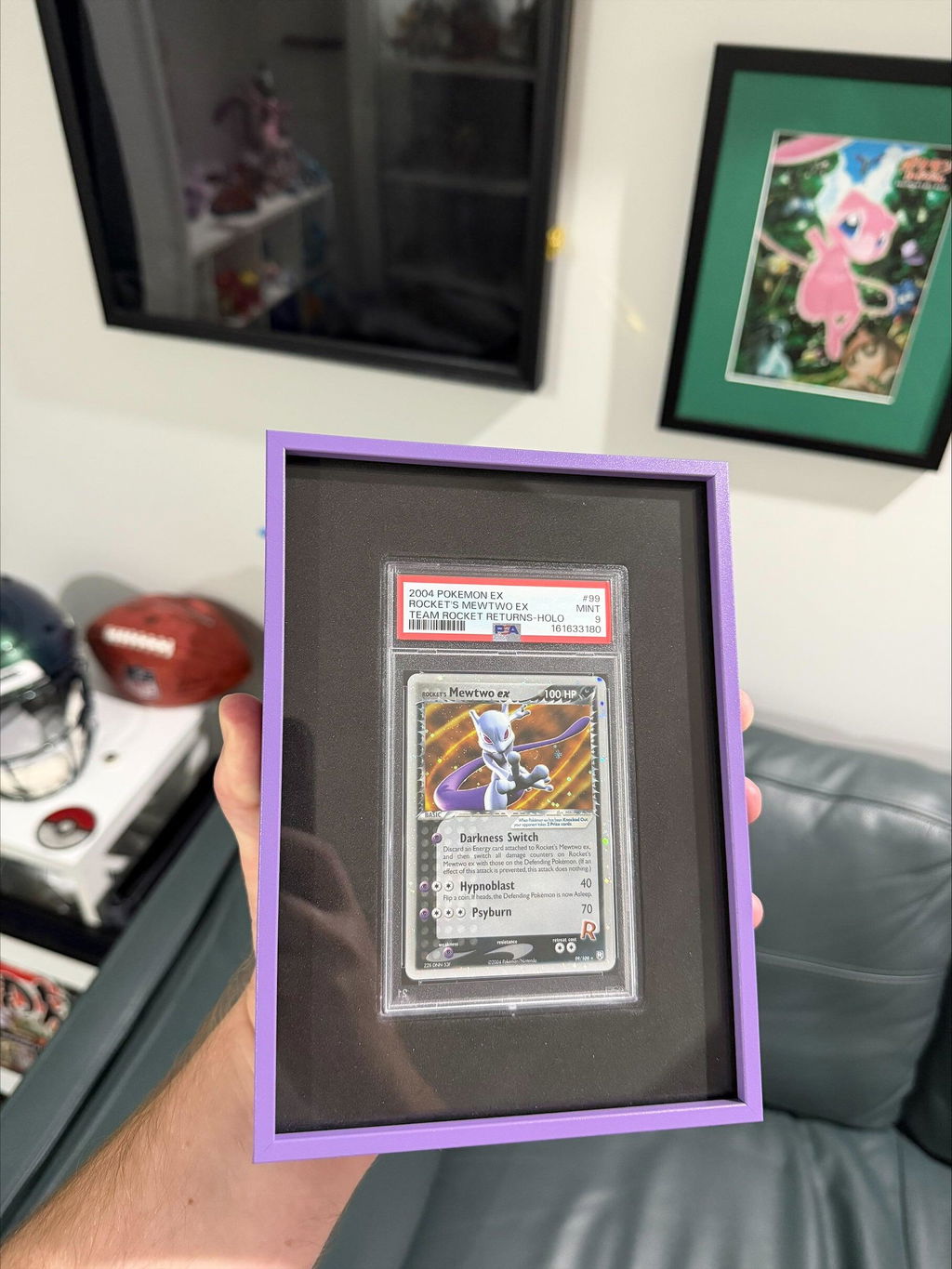
That flexibility is valuable for frames holding graded slabs, One Touch magnetic card holders and raw TCG cards. Lighting can improve readability without requiring a large fixture near the wall.
However, a successful lighting design should make the cards easier to see rather than overwhelm the glazing with reflections or hotspots.
Do LED lights emit ultraviolet radiation?
Many ordinary white LED products emit relatively little UV compared with some traditional light sources. However, LEDs are not one universal spectrum. Products exist specifically to emit UV, and different white or coloured LEDs can have different output characteristics.
When lighting a valuable trading card display, choose products intended for ordinary visible illumination and check manufacturer information if their spectral output is important.
Low UV emission is useful, but it is not the same as eliminating all light-related ageing.
Visible light can also cause fading
Visible light is what allows the collector to enjoy artwork, foil texture and labels. Some wavelengths can also contribute to photochemical changes in printed materials.
The Library of Congress's conservation guidance explains that visible light can remain damaging even when UV and infrared have been reduced. The effect depends on the object's materials and its cumulative exposure.
A UV-resistant acrylic display front therefore complements sensible lighting habits rather than making brightness and operating time irrelevant.
Brightness and duration matter more than decorative colour alone
A collector may spend considerable time choosing between warm white, cool white and RGB lighting. Those choices affect appearance, but the total light falling on the cards and the length of exposure are also essential.
A modest light used for a short viewing session can be a more considered option than a powerful spotlight left on continuously. Using a dimmer or a simple switch makes it easier to illuminate the collection only when it is being enjoyed.
Do not assume that a particular colour setting makes an LED strip completely harmless to every type of trading card ink.
Warm white versus cool white LED lighting
Warm-white lighting can produce a softer interior atmosphere, while cooler white may make certain colours and grading labels appear more neutral or crisp. Neither colour temperature is automatically the best preservation setting for every product.
Colour temperature does not describe the full spectral power distribution or brightness of an LED. Two lamps with the same advertised colour temperature can still differ in how they render card artwork.
For premium trading card displays, choose a light that looks natural in the room and avoid unnecessary intensity.
Does blue light affect Pokémon and TCG cards?
Blue light is part of the visible spectrum and can contribute to light-driven changes in some sensitive colourants. But a claim that every Pokémon, Yu-Gi-Oh!, One Piece or Lorcana card reacts identically to blue light would be unfounded.
Modern TCGs use different inks, coatings, foils and printing processes. Without material-specific testing, it is more sensible to manage overall exposure than declare one LED colour universally safe.
Can LED strips heat a trading card frame?
LEDs are often efficient, but the strip, power supply and mounting surface can still generate heat. Poor ventilation or crowded internal placement may increase temperatures near the display.
Keep power supplies accessible, use lighting components according to their manufacturer's instructions and avoid installing heat-generating parts where they contact a card, sleeve or slab.
For a sealed or deep wall frame, lighting design should consider heat as well as brightness and reflections.
Top lighting, side lighting and edge lighting
Each arrangement produces a different result:
| Lighting method | Visual effect | What to watch |
|---|---|---|
| Top lighting | Emphasises the upper edge and gives a directional look | Hotspots and reflections across upper slab rows |
| Side lighting | Creates depth and accent across the card grid | Uneven brightness from side to side |
| Internal edge strips | Produces a continuous border of light | Visible individual LEDs and heat in enclosed spaces |
| External spotlight | Can illuminate an entire display from the room | Direct glare on acrylic and graded holders |
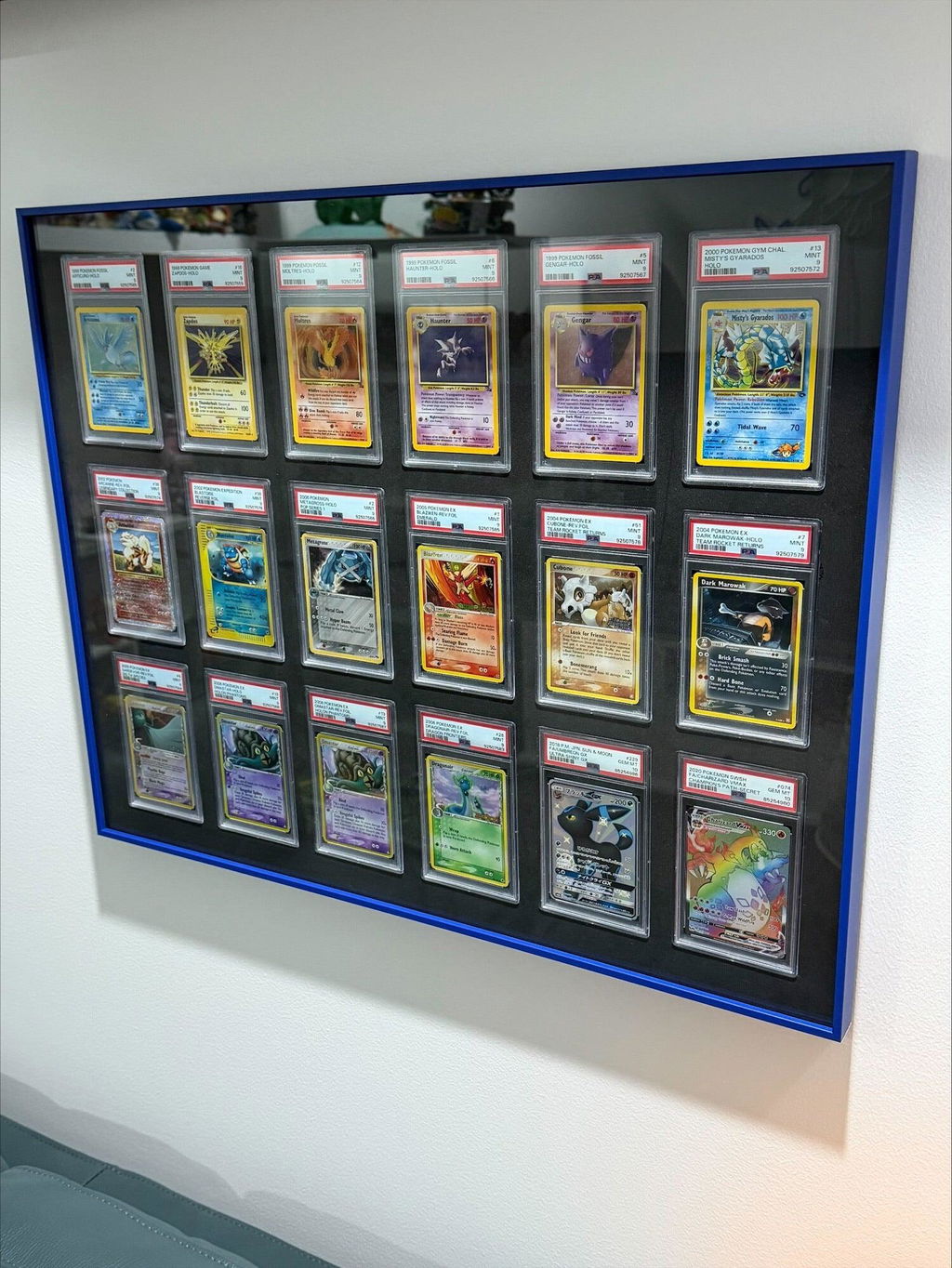
There is no single best layout for every 9-, 18-, 36- or 54-card frame. Test the lighting with the finished acrylic or glass and actual card holders before installing it permanently.
Why graded slabs create extra reflections
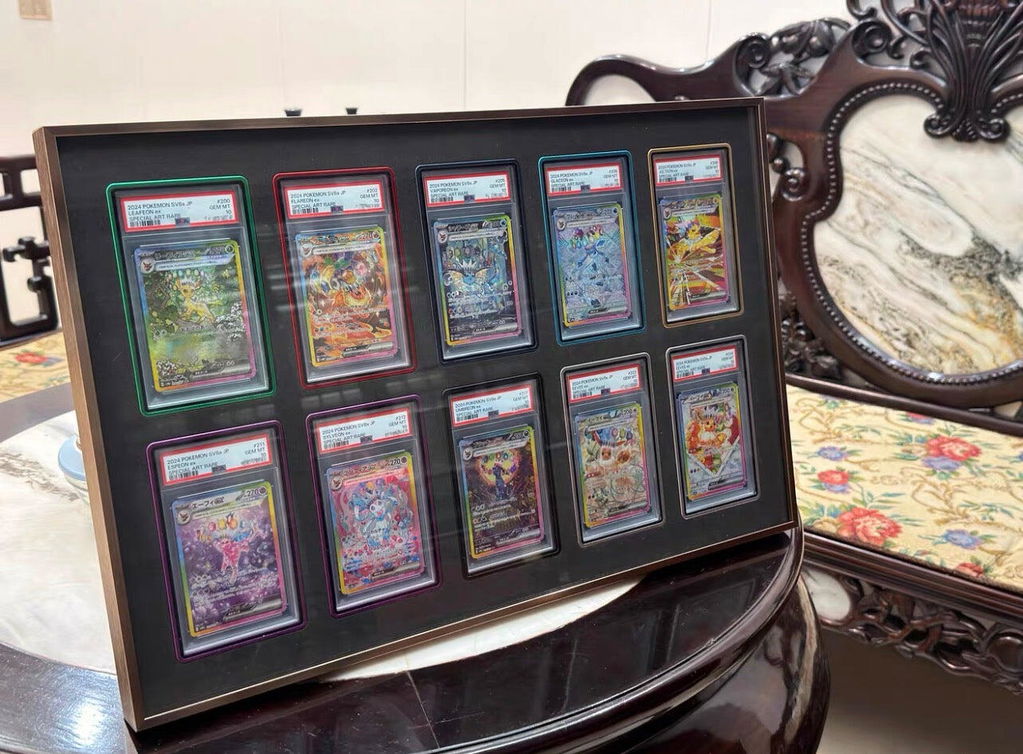
A PSA, BGS or CGC slab introduces another glossy clear surface behind the front glazing. A bright LED can reflect from the outer acrylic, the slab face and the printed label.
Those layers can make a display look less clear even when every material is individually transparent. Diffused lighting and careful positioning often solve more of the visual problem than simply increasing brightness.
If reflections remain distracting, specialist anti-reflective glazing is an additional option to consider.
LED lighting for One Touch magnetic holder displays
One Touch card holders can look very clean under controlled lighting, especially when arranged in a uniform grid. But they create many of the same reflection challenges as graded slabs.
Sports card patch holders can be particularly thick, changing the distance between the card and the frame front. Test the actual holder depth and lighting position rather than assuming a design used for sleeved TCG cards will look identical.
For holder-specific protection questions, see Do One Touch Magnetic Card Holders Block UV Light?.
Does acrylic glazing block LED light?
A clear acrylic sheet is intended to transmit visible light so that the cards can be seen. UV-filtering acrylic may reduce specified ultraviolet wavelengths without removing most ordinary viewing light.
That is why UV protection and visible-light exposure are separate issues. A frame can have excellent UV-resistant acrylic while an overly bright LED still shines visible light onto the collection.
Anti-reflective and anti-glare glazing address presentation rather than acting as universal light-damage prevention.
How to position lights around a trading card wall
- Position the actual PSA, BGS, CGC or One Touch holder behind the chosen glazing.
- Test the light while standing at the normal viewing distance.
- Check whether labels, foil surfaces or the acrylic front reflect the fixture.
- Use diffusion or adjust the light angle before increasing brightness.
- Keep heat-generating components separated from the cards and holders.
- Include a convenient way to switch off or dim the lighting.
Should you leave a trading card LED display on all day?
For a collection whose long-term appearance matters, unnecessary continuous lighting is easy to avoid. Switching lights off when nobody is viewing the display reduces cumulative exposure and energy use.
That does not mean a decorative frame must remain dark most of the time. It means lighting duration is another design choice under the collector's control, alongside brightness and wall location.
Does direct sunlight matter more than LED lighting?
Direct sunlight is generally a much more intense and less controlled source of illumination. It also includes ultraviolet radiation and can add heat to a room or frame.
For that reason, placing a trading card display away from direct sun is a strong first step. UV-filtering acrylic or glass can help manage incoming radiation, but a sunny wall is not automatically preferable just because the frame has a high UV rating.
Lighting Pokémon, Magic: The Gathering, One Piece and Lorcana cards
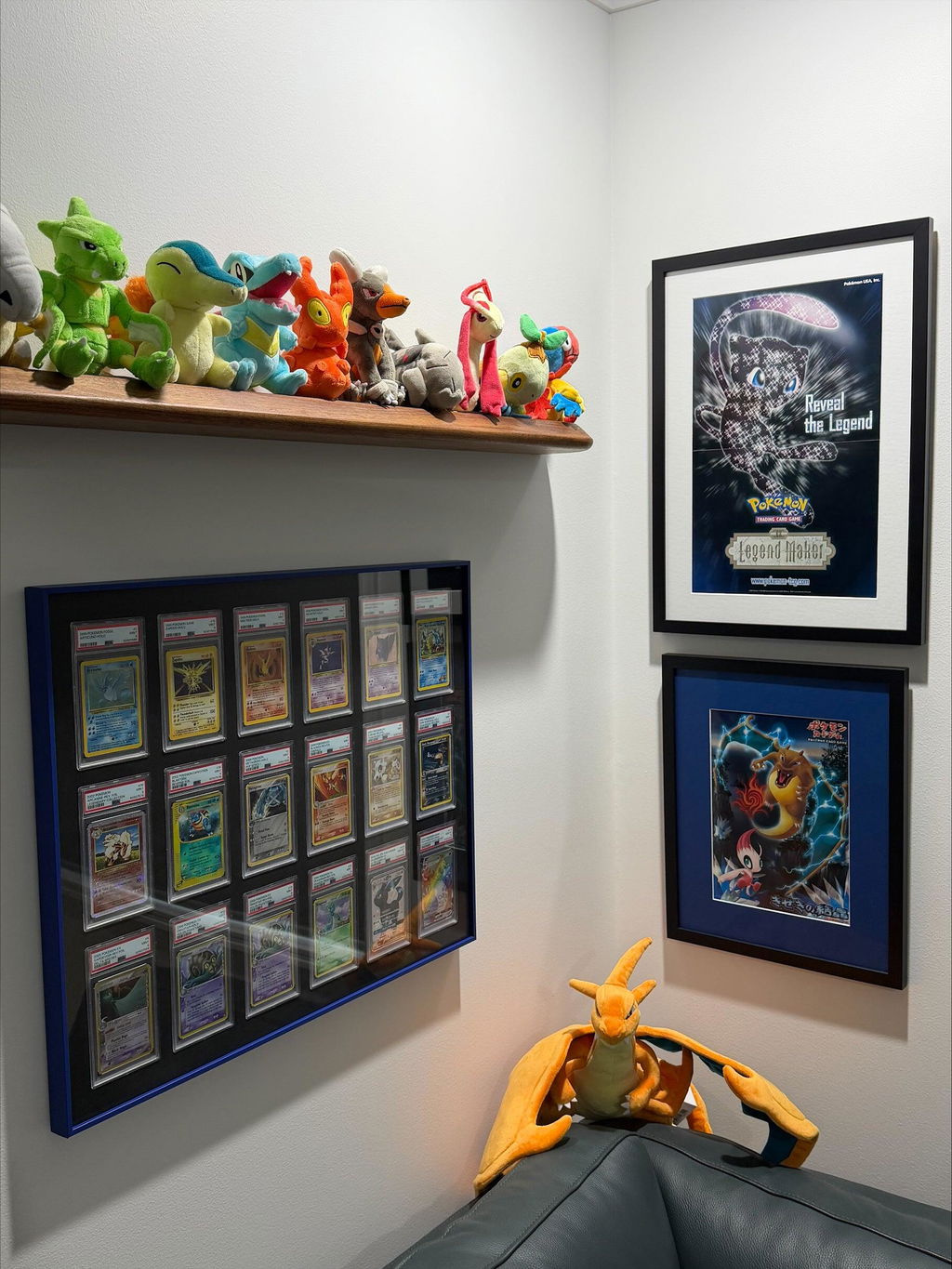
Foil and textured Pokémon cards, MTG full-art cards, Yu-Gi-Oh! holographics, One Piece alternate arts and Disney Lorcana enchanted cards all benefit visually from considered lighting. The objective is to reveal their details without creating a wall of glare.
These trading card games do not each require an invented special LED spectrum. Instead, use appropriate intensity, diffusion, viewing angle and timing for the individual frame and room.
Common LED trading card display mistakes
- Installing the strip before testing reflections through the final glazing.
- Choosing maximum brightness when a softer setting would look cleaner.
- Leaving decorative lights running unnecessarily.
- Placing power supplies or hot components too close to the cards.
- Assuming low UV output means visible light cannot contribute to fading.
- Using exposed LED points that reflect repeatedly off PSA slabs or One Touch holders.
Frequently asked questions
Do LED lights fade Pokémon cards?
Visible light can contribute to cumulative changes in some printed materials, including trading cards. Sensitivity depends on the card, light intensity and duration.
Are LED strips safe for PSA graded cards?
Suitable LEDs can be practical display lights, but brightness, heat and exposure time should still be controlled.
Do LEDs produce UV radiation?
Many ordinary white LEDs emit relatively little UV, but products differ and dedicated UV LEDs exist.
Is warm white safer than cool white for trading cards?
Colour temperature alone does not establish the full spectrum or light dose. Choose a controlled brightness and appropriate fixture.
Can blue LED lighting damage foil cards?
Visible wavelengths can contribute to deterioration in some materials. The actual effect depends on the card and exposure, so no universal safe or unsafe colour can be assigned to every foil.
Does UV-resistant acrylic make LED lighting completely safe?
No. UV filtering does not remove all visible light, and total exposure remains relevant.
Should graded display lights be switched off overnight?
Switching off unnecessary decorative lighting is a simple way to reduce cumulative exposure.
Final thoughts
LED lighting is a valuable design tool for trading card displays, particularly for foil artwork, PSA slabs and One Touch magnetic holders. But low-UV lighting and zero light-related risk are not the same claim.
Choose sensible brightness, avoid unnecessary heat, control reflections and use lighting when the collection is being enjoyed. Combined with appropriate glazing and a wall away from direct sunlight, that approach produces a premium presentation without relying on exaggerated protection claims.
Continue Exploring
These guides cover UV protection, acrylic glazing and practical trading card wall displays.
📚 Collector Guides
-
UV Protection for Trading Card Display Frames
The complete guide to UV wavelengths, acrylic and glass filtration. -
How to Make a Trading Card Wall Display
Understand holder formats, frame materials, layout and lighting options. -
How to Display Graded Cards on a Wall
Plan PSA, BGS and CGC display layouts and presentation.
🛒 Shop Display Collections
-
Aluminium Trading Card Wall Display Frames
Explore aluminium trading card display layouts and frame finishes. -
One Touch Wall Display Frames
Display magnetic card holders in wall-mounted frames.

0 comments