


A trading card display frame does more than organise a collection. Its front glazing changes how the cards look, how much the finished display weighs and how different wavelengths of light reach the items behind it. That makes UV protection one of the most useful subjects to understand before framing Pokémon, sports cards, Magic: The Gathering (MTG), Yu-Gi-Oh!, One Piece, Disney Lorcana or a valuable graded collection.
If you have searched for UV protection for trading cards, UV-resistant acrylic for display frames, acrylic versus glass UV filtration or whether PSA slabs block UV light, the terminology can be confusing. Standard acrylic, UV-stable acrylic, conservation glazing and museum-grade anti-reflective acrylic are often discussed as though they all do the same job. They do not.
This is a complete educational guide to trading card game (TCG) display glazing and light exposure. It explains the science behind ultraviolet radiation, how to read acrylic specifications and filtration graphs, how PSA, BGS and CGC graded slabs and One Touch magnetic holders fit into the picture, and how to choose sensible lighting and display locations. The aim is to help collectors understand the materials rather than rely on a single marketing percentage.
Start with the most important distinction: UV protection is not complete light protection
Ultraviolet radiation can contribute to deterioration, fading and changes in printed materials. Filtering it is useful. But UV is only part of the light that reaches a displayed card. The visible portion of sunlight can also cause colour changes, and strong sunlight can heat a frame and its contents.
That is why a frame advertised as having 99% UV protection should not be interpreted as a promise that the card inside can never fade. The percentage may be entirely legitimate within the manufacturer's specified wavelength range, while other sources of light-driven change still remain.
For most collectors, whether they are displaying a single Pokémon card or a full wall of PSA graded slabs, the strongest approach combines appropriate glazing, sensible wall placement, controlled lighting and realistic display duration. Each does a different job.
What actually causes trading cards to fade?
Trading cards are layered printed objects. Depending on the manufacturer and release, they may include paperboard, printed inks, coatings, adhesives, metallic or holographic foils, surface textures and signed ink. A modern Pokémon full-art card, a vintage sports card and a foil Magic: The Gathering card need not respond to light in the same way.
Some light energy can initiate chemical reactions within dyes, pigments, binders or other materials. Collectively, light-driven chemical changes are described as photodegradation. Visible effects can include fading, discolouration, yellowing or a change in contrast or gloss. Heat and humidity can create additional problems independent of UV filtration.
Two concepts matter when thinking about fading:
- Light intensity: how much light reaches the card at a given moment.
- Exposure time: how long the card receives that light, including repeated exposure over months and years.
Conservation specialists often assess cumulative light exposure rather than looking only at the brightness of a room at one instant. A short period of strong direct sun can matter, but so can a much longer period under less intense lighting. Actual fading sensitivity varies enormously among inks, prints and finishes, so there is no scientifically defensible universal safe number of hours for every trading card.
Understanding ultraviolet radiation: UVA, UVB and UVC
Light can be described by its wavelength, measured in nanometres (nm). Ultraviolet radiation sits beyond the violet edge of human vision. The conventional UV-to-visible boundary is around 400 nm, although some technical standards draw practical distinctions near 380 nm.
| Radiation band | Approximate wavelengths | Relevance to trading card displays |
|---|---|---|
| UVC | 100–280 nm | Solar UVC is effectively absorbed by the atmosphere before it reaches ordinary indoor collections. |
| UVB | 280–315 nm | Atmospheric filtering removes much of it, and common window glazing reduces a substantial proportion. |
| UVA | 315–400 nm | The longer-wavelength UV band is particularly relevant to daylight entering buildings and to comparing glazing specifications. |
| Visible light | Approximately 400–700 nm | Allows us to see card artwork but can also contribute to the fading of light-sensitive materials. |
For a TCG display frame, the difference between blocking radiation below 320 or 330 nm and filtering UV close to 400 nm is meaningful. A glazing product can perform very well against shorter wavelengths while allowing more of the longer UVA band through. The distinction applies whether the frame holds raw Yu-Gi-Oh! cards, One Touch holders or an array of graded slabs.
Why wavelengths matter more than a generic UV-protection label
Imagine two clear glazing materials. One manufacturer provides a graph showing almost no transmission below 330 nm, while another specifies very high UV reduction across a band reaching towards 400 nm. Both may reasonably be described as UV-resistant, yet the second specification covers more of the ultraviolet spectrum.
This does not automatically make one the correct purchase for every frame. The location, intended use, optical finish and price all matter. But the wavelength range gives collectors a real technical basis for comparison.
The Canadian Conservation Institute's guidance on ultraviolet filters explains why percentages without a defined testing range can be misleading. For anyone comparing acrylic suppliers, that is an excellent principle to remember.
Does ordinary clear acrylic block UV light?
Many ordinary clear acrylic sheets reduce some UV radiation, but the amount depends on the formulation. Acrylic is not one universal optical specification.
Most clear acrylic used for glazing is based on polymethyl methacrylate, often abbreviated PMMA. Different grades can include additives and manufacturing characteristics that affect UV transmission. A sheet selected primarily for general-purpose clarity is not necessarily equivalent to a conservation-grade UV-filtering sheet.
Never assume an entire category of plastic blocks a fixed percentage of all UV. The reliable answer comes from the data sheet for the particular product, including sheet thickness and the tested wavelength range. That is just as true for acrylic in a single-card Pokémon display as it is for the glazing across a large PSA or BGS slab display frame.
UV-resistant, UV-stable and UV-filtering acrylic are different descriptions
Three terms are regularly confused in product descriptions:
- UV-stable acrylic generally focuses on how well the sheet itself withstands UV exposure without unwanted changes such as yellowing or loss of clarity.
- UV-resistant acrylic is a broader description that may refer to the material's durability, its filtering performance or both. The specification needs to clarify what is meant.
- UV-filtering acrylic explicitly focuses on reducing the UV radiation transmitted through the sheet to an object behind it.
A sheet can remain optically clear outdoors without being designed as a specialist museum filter. Conversely, conservation glazing is chosen specifically because of what it prevents from passing through to the displayed object. Those are two different technical questions.
How UV-filtering acrylic works
UV-filtering acrylic may use the absorption characteristics of the polymer itself or additives designed to reduce UV transmission. When radiation reaches the sheet, a portion can be absorbed, a portion reflected and a portion transmitted. The balance varies by wavelength.
For a display, the transmitted portion is the most relevant: it describes how much of the incoming radiation continues through the glazing towards the card.
Specialist materials are engineered so that transmission is high across much of the visible spectrum, allowing the card to remain easy to see, while transmission is substantially lower in selected ultraviolet wavelengths. Achieving strong UV filtration and a clear visual appearance at the same time is one reason technical glazing grades differ from inexpensive general-purpose sheets.
What does 99% UV protection mean for acrylic?
A reported 99% reduction indicates that approximately 1% of the UV quantity measured under the specified test conditions is transmitted or remains, depending on how the manufacturer expresses the result. It does not necessarily mean exactly 99% is removed at every individual wavelength from 100 to 400 nm.
Before comparing percentages, check these four details:
- Wavelength range: Does the test cover 300–380 nm, 280–400 nm or a different band?
- Measurement method: Is the number an integrated percentage or a reading at specific wavelengths?
- Material thickness: Was the exact thickness being purchased tested?
- Product identification: Does the report refer to the actual material rather than a different grade from the same manufacturer?
The same questions apply to claims of 90%, 95%, 98%, 99% or 99.7% UV protection. A smaller headline number over a wider wavelength range is not directly comparable to a larger number over a narrower range without the underlying data.
How to read an acrylic UV transmission graph
A spectral transmission graph is one of the most useful documents an acrylic supplier can provide. It usually has wavelength in nanometres along the horizontal axis and percentage of light transmitted on the vertical axis.
To interpret the graph, work from left to right:
- Find 300 nm, 320 nm, 350 nm, 380 nm and 400 nm on the wavelength axis.
- Look at the transmission percentage at each point, rather than relying only on the product headline.
- Identify where the curve rises sharply. This is often called the cutoff region or transmission edge.
- Continue into the visible spectrum to understand how much viewing light the product transmits.
- Compare products at the same wavelengths wherever possible.
A curve that stays close to zero through most of the UV band and rises sharply near its upper boundary behaves differently from a curve that begins transmitting much earlier. This is the kind of distinction that a generic “UV-resistant” label cannot communicate.
What is a UV cutoff wavelength?
A cutoff wavelength is a way of describing where a material's transmission changes significantly. It is not always a perfectly sharp line: real materials can have transition regions rather than switching instantly from zero transmission to full transmission.
If a sheet is described as blocking light below approximately 330 nm, that does not establish its behaviour at 350, 370 or 390 nm. Those values must be examined separately. A specialist sheet advertised with protection extending towards 400 nm is making a meaningfully different claim.
Technical documents may define cutoffs differently, so compare full graphs whenever possible.
Does acrylic thickness affect UV protection?
Thickness can affect the amount of radiation transmitted through an absorbing material, but it is not a simple substitute for choosing the correct UV-filtering grade. Doubling the thickness of ordinary acrylic does not magically convert it into museum-grade glazing.
For trading card frames, thickness also affects flex, weight, edge support and handling. A large graded slab display holding dozens of PSA, BGS or CGC cards may need a thicker front panel for rigidity even when the desired UV performance is already achieved by the material formulation.
When comparing 2 mm, 3 mm or thicker sheets, ask the supplier for performance data applicable to those actual products and choose the physical thickness based on the panel span and support arrangement.
Cast acrylic versus extruded acrylic
Cast and extruded acrylic are two common manufacturing categories. They can differ in tolerances, surface properties, processing behaviour and available grades. Both can be suitable for display-frame glazing.
However, **cast versus extruded is not itself a UV-filtration rating**. A collector should not conclude that every cast sheet offers stronger UV protection or that every extruded sheet is unsuitable. The exact formulation, manufacturer documentation and intended application are more important than the manufacturing label alone.
If a frame uses laser-cut or machined acrylic, manufacturing method may also influence edge finishing and workshop handling, but those considerations are separate from the UV performance of the finished front panel.
Standard, conservation and museum-grade acrylic
It is more useful to think about acrylic glazing as a range of documented products than as a rigid three-step hierarchy. Even so, the following categories help explain what buyers are comparing.
| Glazing type | Main purpose | What to verify | Typical reason to choose it |
|---|---|---|---|
| General clear acrylic | Clarity, low weight and a physical cover | Actual UV transmission and sheet quality | Simple indoor displays where the specification suits the location |
| Premium UV-resistant acrylic | Clear presentation with documented UV resistance | Rated wavelength range and transmission curve | Quality everyday trading card framing |
| Conservation UV-filtering acrylic | More extensive UV reduction | Manufacturer's UV testing and optical properties | Collections where broader filtering is desired |
| Museum-grade anti-reflective acrylic | High UV filtration plus reduced reflection | UV percentage, wavelength range, surface treatment and care instructions | Premium presentation with a specialist optical finish |
Some products are both conservation grade and anti-reflective, while others prioritise one feature. Compare the actual properties, not just the marketing tier.
What is museum-grade acrylic?
Museum-grade acrylic is a term generally used for high-performance glazing intended for artwork, photographs, documents and other valuable displayed materials. Products in this category may provide very high UV filtration, specialist coatings, exceptionally low reflectance or additional surface treatments.
Not every product described as museum-grade has identical specifications. One may emphasise UV filtration, another reflection reduction, and another both. The manufacturer's technical documentation is the reliable basis for comparison.
For collectors, the appeal is understandable: valuable cards can be displayed behind materials developed for demanding visual environments. That additional specification is an option, not a requirement that every trading card display must meet.
Anti-reflective acrylic and UV protection are separate features
Anti-reflective glazing reduces visible reflections from windows, room lights and objects opposite the frame. UV-filtering glazing reduces transmission of ultraviolet radiation. A product may offer one benefit, both benefits or neither at a specialist level.
Reflection control matters particularly for trading cards because many are viewed through multiple clear surfaces: the frame front and the PSA, BGS, CGC or magnetic holder itself. Glossy labels and holographic cards can add further reflections.
When evaluating an anti-reflective product, look for a reflectance figure and consider how it was measured. Some diffuse or matte anti-glare sheets reduce harsh mirror-like reflections but can soften the image when the displayed object sits well behind the sheet. High-grade anti-reflective coatings are designed for a different optical result.
Acrylic versus glass: which blocks more UV?
There is no universal winner. Ordinary glass, UV-filtering glass, general acrylic and conservation acrylic have different spectral properties. A basic acrylic sheet can outperform some ordinary glass in one wavelength range, while specialist glass can outperform general acrylic in another.
For the UV question, compare specific products and their documented transmission. For the wider display-frame decision, consider weight, impact resistance, scratch resistance, flex, clarity and reflections.
| Consideration | Acrylic glazing | Glass glazing |
|---|---|---|
| Weight | Usually substantially lighter at comparable thickness | Heavier, increasingly noticeable in large displays |
| Impact behaviour | Generally more impact-resistant than ordinary glass | Can break or shatter, depending on glass type |
| Scratch resistance | More susceptible to scratching without special treatments | Ordinary glass is generally harder |
| UV filtration | Ranges from general-purpose grades to specialist UV-filtering products | Ranges from ordinary glazing to specialist conservation glass |
| Reflection control | Anti-reflective options available | Anti-reflective options available |
| Large frame practicality | Low weight is often an advantage | Higher weight must be considered in mounting and transport |
What about polycarbonate and other clear plastics?
Some clear display products use polycarbonate rather than acrylic. Polycarbonate can be highly impact-resistant, and its optical and UV characteristics depend on the particular grade and any additives or coatings.
Material names are often used casually in product listings, so it is worth confirming whether a front is acrylic (PMMA), polycarbonate, PET or another transparent plastic. Their scratch behaviour, rigidity, appearance and spectral transmission are not necessarily interchangeable.
Do PSA slabs block UV light?
A PSA slab is a protective holder, but it is important to distinguish the holder's physical protection from a quantified UV-filtration specification. PSA announced a redesigned standard trading card holder in 2024 and described the new polymer as more resistant to UV damage from sunlight, alongside improved durability and scratch resistance.
That announcement should not be converted into an invented claim that every PSA holder from every production period blocks a fixed percentage of all UV. Holder generations differ, and a statement about the polymer's resistance to damage is not necessarily a complete spectral transmission report for the card inside.
PSA also recognises sunlight fading as a possible change in an encapsulated card's condition. A PSA graded slab is therefore no reason to leave a valuable Pokémon, Yu-Gi-Oh! or sports card in direct sun indefinitely. See PSA's 2024 holder update for the manufacturer's wording.
Do BGS and CGC graded slabs provide UV protection?
Beckett and CGC holders are designed for encapsulation and presentation, but the presence of a slab should not be treated as a universal percentage of UV protection. A grading company's descriptions of clear optics, archival materials or anti-counterfeit UV features do not, by themselves, establish a numerical UV-filtration curve.
If a UV percentage matters to your setup, check documentation for the particular generation of holder rather than assuming PSA, BGS and CGC all perform identically. A surrounding graded trading card display frame can have its own independently specified acrylic or glass glazing, regardless of which grading company encapsulated the card.
Do One Touch magnetic card holders have UV protection?
Many magnetic holders are advertised with UV-blocking features, but that cannot be assumed for every product from every manufacturer. Ultra PRO, for example, describes UV-blocking additives in its ONE-TOUCH range.
Look at the exact One Touch model, especially when buying magnetic trading card holders from different brands or combining older and newer products. A broad claim of UV protection is useful context, while detailed wavelength and percentage data is needed for a precise technical comparison.
One Touch magnetic holders can be placed inside a larger trading card display frame, creating separate layers: the holder around the card and the outer UV-resistant acrylic or glass glazing across the wall display. Each layer has its own purpose and properties. This arrangement is popular for sports cards, Pokémon favourites and other TCG cards that collectors prefer to keep ungraded.
Are top loaders and penny sleeves UV protective?
Top loaders and sleeves vary in material, thickness and intended use. A sleeve designed primarily to reduce handling wear, surface contact or contamination is not automatically a specialist UV filter.
Some accessory manufacturers specify UV-blocking materials; others do not. If UV filtration is an important purchasing criterion, check the exact sleeve or top loader specifications instead of relying on its clarity, colour or thickness as a substitute for test data.
For raw and sleeved TCG collections, including Magic: The Gathering, Yu-Gi-Oh! and Disney Lorcana cards, the outer frame's glazing may be the most clearly documented light-filtering layer available to the collector.
Do multiple layers of acrylic add more UV protection?
When light travels through several materials, each layer can affect the remaining transmitted radiation. But simply stacking a UV-advertised holder and a UV-advertised frame does not justify adding two headline percentages or claiming zero exposure.
The combined result depends on which wavelengths each layer reduces. A layer filtering mostly shorter UV wavelengths and another filtering a broader range interact differently from two layers with identical transmission curves.
For a precise combined result, the wavelength-dependent transmission data of both materials would be needed. In everyday collecting, it is enough to recognise that the holder and external glazing can contribute different forms of protection without treating the combined assembly as sunlight-proof.
Does sunlight through a window still damage trading cards?
Yes, it can. Window glass reduces some ultraviolet radiation, but it does not eliminate all relevant wavelengths or the visible-light intensity of daylight. Sunlight passing through a window can still be extremely bright compared with ordinary indoor lighting.
Consider the path of the sun across the year. A wall shaded in the morning may receive direct light in the afternoon. A display that appears safe in winter can receive a different beam of sunlight in summer. Nearby mirrors or reflective surfaces can also change where light falls.
Observing the actual wall over a full day is more useful than assuming an interior room is automatically free of direct sun exposure.
Direct sunlight versus indirect daylight
Direct sunlight is generally the more demanding environment because of its intensity, UV content and associated heat. Indirect daylight can be much gentler, but the difference depends on the room, time of day and duration.
For a valuable collection, choose an interior wall outside direct sun if practical. It is an easy way to reduce exposure before spending money on specialist materials. UV-filtering glazing is valuable, but good positioning remains useful even behind the highest-grade front panel.
Can LED lights fade trading cards?
Potentially, yes. Many suitable LED products emit relatively little UV compared with some older light sources, but they still produce visible light. Visible light contributes to the total exposure of a light-sensitive printed object.
A softly lit trading card display frame used for occasional viewing is a different situation from a very bright display illuminated continuously. Keep the lighting as bright as necessary for a pleasing view, not brighter simply because the fixtures can produce more output. This applies to illuminated PSA slab walls, One Touch sports card displays and raw TCG card arrangements alike.
LED strips, spotlights and integrated lighting also need sensible positioning and heat management. A light source should not be pressed against sensitive materials or create unnecessary heat in a sealed frame.
How much light is too much for trading cards?
There is no universal trading-card exposure threshold because the light sensitivity of individual inks, coatings and signatures is not known. Museum references sometimes describe illumination in lux and cumulative exposure in lux-hours, but those recommendations concern particular classes of heritage objects and should not be presented as experimentally proven limits for modern Pokémon or sports cards.
The underlying logic remains useful: lower intensity and shorter duration generally reduce cumulative exposure. A collector can apply that principle without needing expensive laboratory equipment.
What are lux, UV intensity and light dose?
Lux describes the amount of visible light reaching a surface. UV measurements quantify ultraviolet radiation, sometimes expressed in relation to visible-light output. Light dose combines intensity and time, which is why conservation guidance considers how long an item remains on display.
A basic light meter can help compare the brightness of different wall positions. A specialised UV instrument is needed for meaningful UV measurement, and a spectrophotometer is needed to produce a detailed spectral transmission curve for glazing. A phone's brightness estimate is not a reliable way to certify UV protection.
Why holographic and foil trading cards deserve careful lighting
Holographic and foil finishes make trading cards particularly attractive to display, from Pokémon holographics and One Piece alternate-art cards to MTG foils and textured Disney Lorcana cards. They can also make glare and reflection problems more visible because their appearance changes dramatically with viewing angle and illumination.
Do not assume that a holographic card must fade faster or slower than a non-holographic card solely because it has a foil finish. A finished card contains several different materials, and its specific light sensitivity depends on its construction.
For presentation, diffuse lighting and considered viewing angles are often more effective than aiming a bright spotlight directly at the card. Anti-reflective glazing may improve the viewing experience when reflections are a persistent problem.
Vintage cards, signatures and memorabilia cards
Vintage cards can contain older printing materials and may already have experienced decades of storage and display conditions. Signed cards add another variable: autograph inks can have their own fading characteristics. Sports memorabilia cards can combine paper, photographs, fabric and adhesives.
A frame's UV specification remains important, but the collection's materials and history matter as well. For a rare signed or historically important card, minimising intense light and heat is a reasonable priority even if the display uses excellent glazing.
UV protection across Pokémon, MTG, Yu-Gi-Oh!, One Piece, Lorcana and sports card displays
The science of UV and ultraviolet filtration is shared across trading card games, but each collection introduces different holder formats, finishes and presentation priorities. These examples show how to apply the same principles without assuming one TCG requires a different universal UV percentage from another.
Pokémon trading card display frames
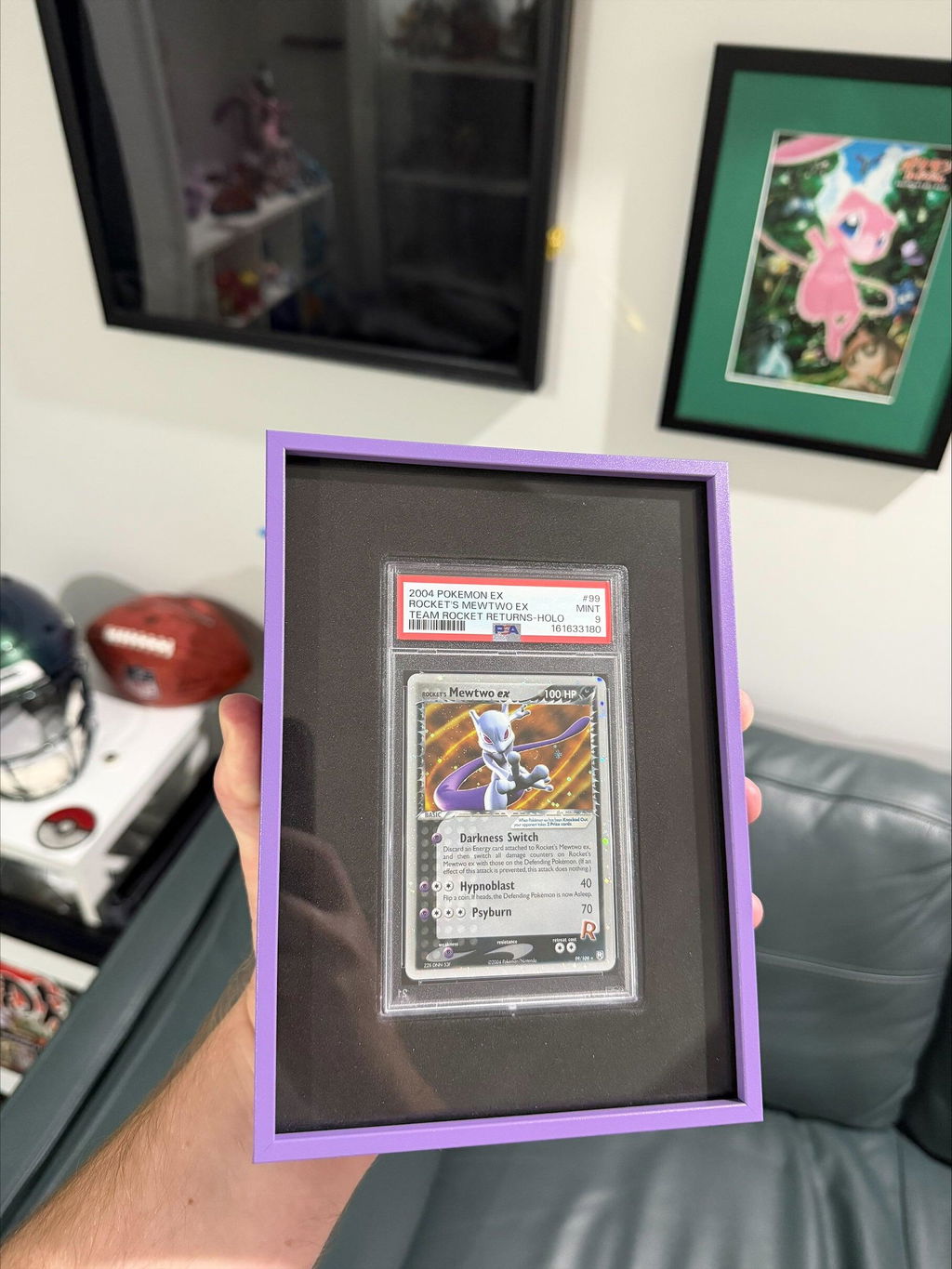
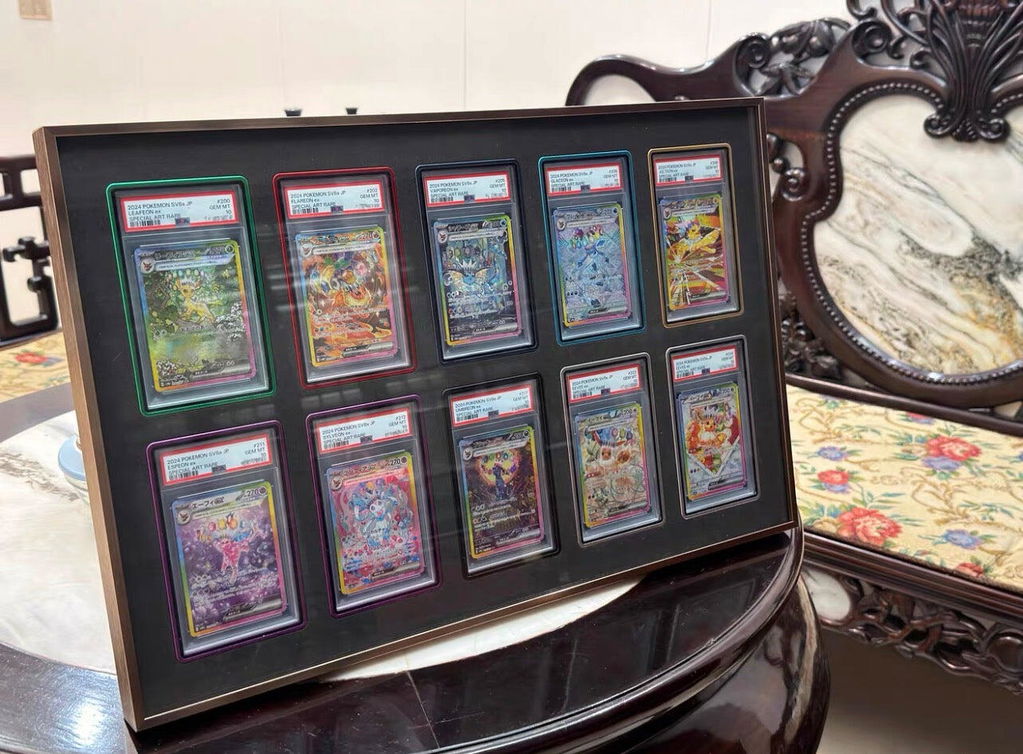
Pokémon collectors may display a single prized holographic card, an evolution line, a complete set, Japanese and English versions of a character, or a wall of PSA, CGC or BGS graded slabs. The light-management principles are shared across those layouts. A high-contrast frame can make Pokémon artwork look dramatic, but wall location and the UV specification of the acrylic glazing remain more important than decorative effects.
For broader construction choices, see the Pokémon trading card wall display guide.
Magic: The Gathering (MTG) and Yu-Gi-Oh! displays
Magic: The Gathering and Yu-Gi-Oh! cards may be framed raw, in sleeves, in rigid holders or as graded slabs. MTG foils and Yu-Gi-Oh! holographic finishes can make reflections particularly noticeable, so visual clarity and lighting angle deserve attention alongside UV-resistant acrylic. For any TCG display frame, choose openings around the actual holder dimensions and obtain glazing data for the material in front.
One Piece and Disney Lorcana display frames
One Piece and Disney Lorcana collections often feature striking illustrations, alternate artwork and foil treatments. A restrained frame with clear acrylic can keep the focus on those details. If a One Piece or Lorcana card is displayed in a magnetic One Touch holder or a PSA graded slab, account for the additional clear surface and any reflections it creates.
Sports cards, autographs and memorabilia holders
Sports card collections often introduce signed cards, patch cards, thicker One Touch cases and graded PSA or BGS slabs. Different inks and memorabilia materials may respond differently to light, so avoid treating a particular sports card's price or slab grade as a UV-filtration specification. Controlled room lighting and a documented acrylic or glass front are sensible parts of the overall display design.
Other trading card games and mixed TCG collections
Collectors of Digimon, Dragon Ball, Flesh and Blood and other trading card games face the same essential choices. For a mixed TCG wall display, organise cards around compatible holder types, then consider the UV-filtering properties of the shared front glazing. The material specification applies to the entire frame, even when the games and card finishes vary.
How a display frame changes UV exposure
A well-planned trading card display frame provides a controlled arrangement and a front glazing layer. Depending on its construction, it can also reduce handling, dust accumulation and the likelihood of cards being knocked or moved. That is useful whether the frame holds graded PSA, BGS and CGC slabs or ungraded TCG cards in One Touch holders.
However, the frame itself should not be confused with an airtight or climate-controlled conservation enclosure. Gaps, backing materials, temperature and room humidity still influence the environment. Think of a display frame as a presentation system that can incorporate protective materials, not a guarantee against every form of ageing.
Air gaps, card holders and contact with glazing
Where possible, plan the frame around the actual cards or holders rather than pushing their faces into the front panel. Graded slabs and magnetic cases add depth. Raw cards are much thinner and may need matboard or another removable support system to keep them positioned safely.
The distance between the object and the glazing can also influence reflections and the effect of some anti-glare finishes. A finish designed to diffuse reflections at close contact may behave differently when a thick slab sits farther behind it.
For DIY construction decisions, the complete DIY trading card wall display guide covers holder depth, matboard, EVA foam, backing and layout planning in detail.
Large trading card displays: glazing thickness and panel size
UV filtration is only one specification in a large frame. The front panel must also be adequately supported so that it does not flex excessively or become awkward to handle. A sheet appropriate for a small three-card display may not be the right physical thickness for a much wider wall display.
Large acrylic panels can be easier to handle than an equivalent glass panel because of their lower weight. The final choice should still take into account frame size, support along the edges, transport, mounting and the acrylic supplier's recommendations.
A thicker sheet may be desirable for rigidity without necessarily offering a fundamentally different UV-filtering formulation. When planning a 20-, 36- or 54-card graded slab display, physical support and UV performance should be evaluated as two separate specifications.
Should expensive trading cards always have museum-grade glazing?
Not necessarily. A good included acrylic option, documented UV resistance and a well-chosen indoor location can be appropriate for many collectors. Specialist conservation or museum glazing becomes attractive when the collector values broader UV filtration, reduced reflection or a particular fine-art presentation standard.
Price and collection value can influence the decision, but the actual light environment is more directly relevant than the market value printed beside the card. A valuable card kept away from direct sun may experience less challenging exposure than a cheaper card displayed in a bright window.
The upgrade question is best answered by the material specification and the collector's preferences, not by treating the most expensive sheet as automatically necessary for everyone.
Choosing the right UV glazing for a trading card display
Before ordering acrylic or glass, work through the following questions:
- Where will the frame hang? Identify direct sunlight, bright windows, ceiling lights and reflective surfaces.
- What is inside? Note raw Pokémon or other TCG cards, signatures, sleeves, One Touch magnetic holders and PSA, BGS or CGC graded slabs.
- What does the supplier actually specify? Look for a wavelength range, transmission data and the exact product name.
- How large is the front panel? Choose physical thickness and frame support for the actual span.
- How important are reflections? Consider anti-reflective glazing separately from UV filtration.
- How often will the display be lit? Occasional decorative lighting and continuous bright lighting create different exposure patterns.
- Will the collection change? Plan access and holder compatibility before sealing the frame.
This approach makes glazing a considered part of the overall display rather than an isolated specification.
How to compare two acrylic data sheets
If two suppliers both advertise premium clear acrylic, the product descriptions may not be directly comparable. Put the technical information side by side.
| Specification | Why it matters | Question to ask |
|---|---|---|
| UV transmission | Shows how much UV passes through | At which wavelengths and using which test method? |
| Visible-light transmission | Influences overall brightness and clarity | Is it measured across the visible spectrum? |
| Reflectance | Affects mirror-like reflections on the front | Is the figure for one surface or both? |
| Haze or diffusion | Can affect sharpness, especially with an air gap | Is this a clear, anti-reflective or matte anti-glare finish? |
| Sheet thickness | Influences rigidity and sometimes optical testing | Is the test for the thickness being purchased? |
| Coating or surface treatment | May influence cleaning, durability and optics | Are there special maintenance requirements? |
Reliable specifications make comparisons easier. Words such as “premium,” “ultra-clear” and “museum quality” can be useful descriptions, but they are not substitutes for defined measurements.
Common mistakes when choosing UV protection
- Assuming all clear acrylic is identical. Formulations and wavelength performance vary.
- Comparing UV percentages without comparing test ranges. The numbers may describe different things.
- Confusing UV stability with UV filtration. A material resisting yellowing is not the same claim as protecting an object behind it.
- Forgetting visible-light exposure. Removing UV does not eliminate every cause of fading.
- Treating a graded slab as a complete sunlight solution. Encapsulation and quantified optical filtration are different properties.
- Choosing anti-glare based only on its name. Diffusing and coated anti-reflective surfaces can look different.
- Ignoring the finished panel size. Excellent UV data cannot compensate for inadequate physical rigidity.
- Overlooking the wall itself. Moving the frame out of direct sun can be an important improvement.
How to protect a trading card display from sunlight
A practical display plan does not have to be complicated:
- Choose a wall that does not receive regular direct sunlight.
- Observe morning and afternoon light, and remember that the sun's angle changes seasonally.
- Use glazing whose UV performance is clearly documented.
- Control strong window light with blinds, curtains or suitable window treatments where needed.
- Avoid placing the display beside radiators, heaters or other concentrated heat sources.
- Use moderate, well-positioned lighting and switch decorative lights off when not needed.
- Review the display occasionally for changes in light patterns, heat or moisture.
How to clean UV-protective acrylic safely
Acrylic is generally more susceptible to scratches than ordinary glass. Dust particles dragged across its surface can leave fine marks, and some household solvents can damage acrylic or specialised coatings.
Follow the manufacturer's instructions for the exact sheet. Typically, that means removing loose dust carefully, using a clean suitable soft cloth and avoiding abrasive pads or aggressive cleaners. Do not assume a coated anti-reflective sheet should be treated exactly like untreated acrylic.
Good cleaning habits help preserve the appearance of a display, but they should not be confused with the underlying UV-filtration specification.
How long does UV-protective acrylic last?
The service life depends on the material formulation, coatings and environment. Some acrylic products are engineered for long-term clarity, while coatings and organic UV-absorbing systems can change after extended exposure. There is no universal expiry date that applies to every UV-filtering acrylic sheet.
For a particular product, refer to manufacturer durability information and care instructions. Inspect the display periodically for scratches, haze, surface changes or unexpected yellowing. The absence of visible changes does not, by itself, measure the current UV transmission, but regular inspection remains useful.
Trading card UV protection myths
Myth: Any acrylic sheet blocks all UV rays
Acrylic formulations vary. Some primarily reduce shorter wavelengths, while specialist grades can filter a broader part of the ultraviolet spectrum.
Myth: A 99% UV label guarantees that a card will never fade
Visible light, heat and cumulative exposure still matter. A UV percentage describes a particular measurement, not a lifetime guarantee of appearance.
Myth: Every PSA, BGS and CGC holder has identical UV protection
Holder construction and published properties differ. Use product-specific information rather than a single assumption for all slabs.
Myth: Museum-grade glazing is the only worthwhile acrylic
Quality clear acrylic with documented UV resistance can be an excellent choice for indoor display. Specialist glazing offers further features for collectors who want them.
Myth: LED lighting cannot affect cards
Low-UV lighting still produces visible light. Intensity and duration remain relevant.
Myth: Thicker acrylic always means better UV filtration
Thickness can affect transmission and rigidity, but the formulation and tested wavelength range are central to UV performance.
Three practical display scenarios
A small indoor Pokémon display
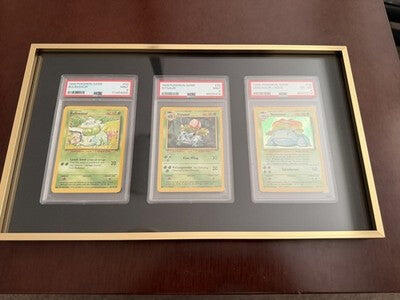
A three-card wall display hangs on an interior wall away from direct sun. The owner wants clear viewing and a simple presentation. A quality clear acrylic with documented UV resistance may suit this environment without requiring the most specialised anti-reflective material.
A large graded trading card wall
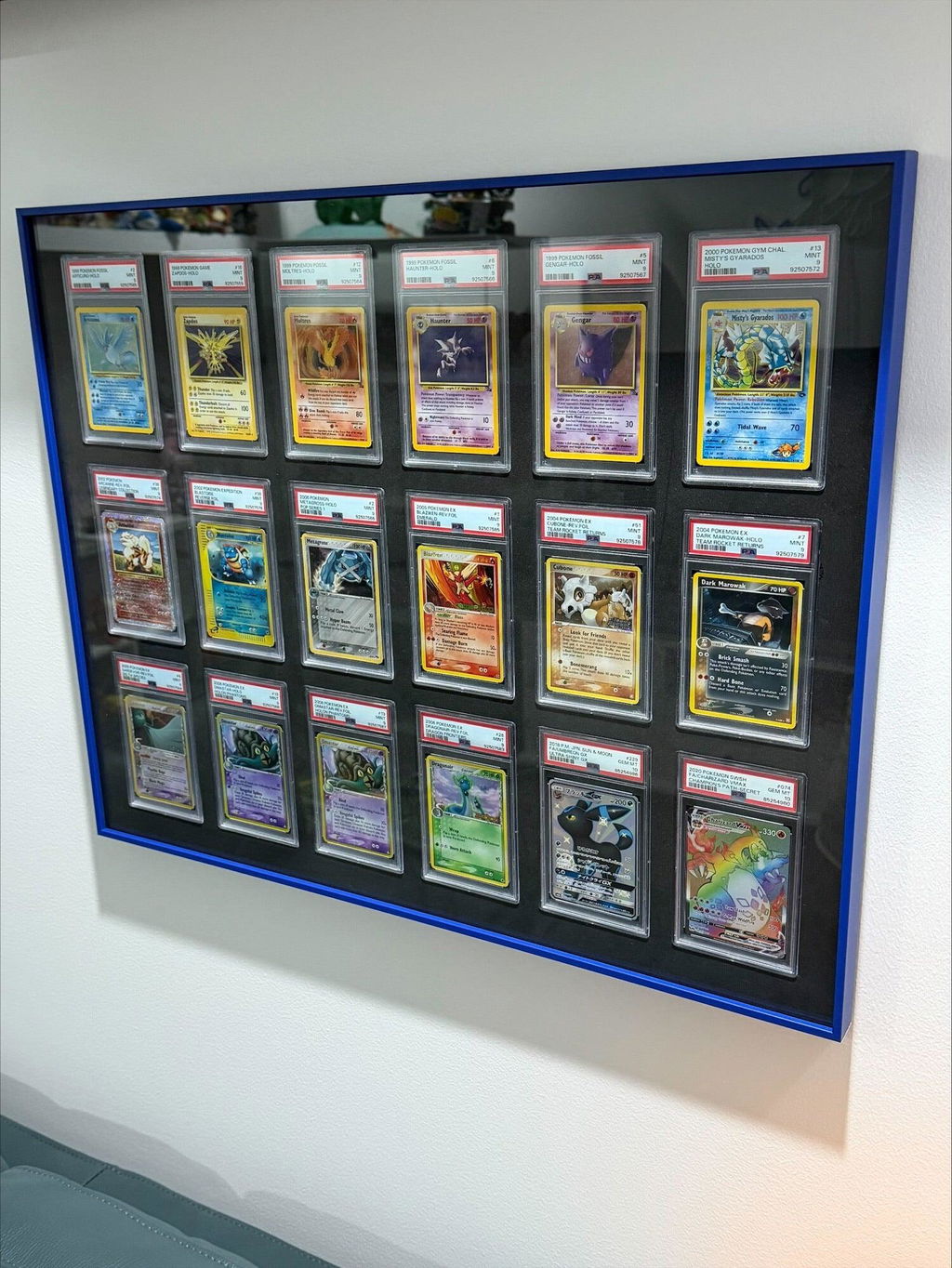
A collection of 36 or 54 PSA, CGC or BGS slabs spans a large wall. Here, glazing weight, panel rigidity, edge support and reflections matter alongside UV filtration. Acrylic is often worth considering because of its comparatively low weight, while a carefully chosen wall position can reduce unwanted sunlight exposure.
A premium sports card display with autographs
A collector is displaying signed and memorabilia cards in rigid holders. They may place extra value on reduced reflections and broader UV filtering, while also choosing lower-intensity lighting and avoiding heat. Specialist glazing becomes a reasonable preference, although the display location is still important.
A quick UV-protection checklist before you mount the frame
- Check where direct sunlight lands during the day.
- Identify the acrylic or glass product and its documented UV performance.
- Read the wavelength range, not just the headline percentage.
- Confirm that the sheet thickness suits the finished frame size.
- Test reflections with a real slab or card holder behind the glazing.
- Keep lighting moderate and avoid unnecessary heat.
- Plan access for future card changes and cleaning.
Frequently asked questions
Does UV light damage trading cards?
It can contribute to fading and other material changes over time. The sensitivity varies with the inks, coatings and construction of the individual card.
Does acrylic block UV light?
Many acrylic sheets reduce some UV, but their wavelength coverage and performance vary. Look for data for the actual material.
How much UV does regular acrylic block?
There is no universal percentage for all regular acrylic. Some grades reduce shorter wavelengths strongly, while specialist UV-filtering sheets are designed to cover a broader band.
Is 99% UV-blocking acrylic worth it for trading cards?
It can be appealing for collectors who want a high level of UV filtration. Whether it is worth the additional cost depends on the frame's location, the product's actual specification and the buyer's priorities.
Does 99% UV protection mean no fading?
No. Visible light and environmental conditions also influence deterioration. The figure is a UV-filtration measurement, not a promise that colours will remain unchanged forever.
Is UV-resistant acrylic the same as museum-grade acrylic?
Not necessarily. Museum-grade products may offer broader UV filtration, anti-reflective coatings or other specialist optical features. Compare the actual data sheets.
Does UV pass through glass windows?
Some wavelengths can pass through ordinary windows, especially parts of the UVA band. Windows also transmit visible daylight, which contributes to the total light exposure of displayed cards.
Are PSA graded cards protected from sunlight?
A PSA slab offers encapsulation, and holder designs have evolved. That does not make prolonged direct sunlight a recommended display condition.
Do CGC and BGS slabs block UV rays?
Do not assign a universal blocking percentage without product-specific test data. Check the holder's documented properties and consider the external frame glazing independently.
Are Ultra PRO One Touch holders UV resistant?
Ultra PRO describes UV-blocking additives in its ONE-TOUCH holder range. Check the exact product model for its stated properties.
Is a One Touch holder enough UV protection for a trading card wall display?
A UV-advertised One Touch magnetic holder can contribute useful filtering, but its rating should be read separately from the frame's acrylic or glass specification. Strong direct sunlight remains a poor choice for displaying valuable sports cards or TCG cards.
Does UV-resistant acrylic work with PSA, BGS and CGC graded slabs?
Yes. UV-filtering acrylic can be used as the front glazing of a graded slab display frame regardless of whether it contains PSA, BGS or CGC holders. The acrylic's published filtration applies to the light passing through that front panel; it does not depend on the grade printed on the slab.
Can Pokémon, Yu-Gi-Oh!, One Piece and Disney Lorcana cards fade on display?
Like other printed objects, trading card game cards can be affected by prolonged light exposure. The precise sensitivity varies by card and finish. Avoiding direct sunlight and selecting suitable display glazing is relevant across Pokémon, Yu-Gi-Oh!, One Piece and Lorcana collections.
Should Magic: The Gathering foil cards use UV-protective glass or acrylic?
Both specialist UV-filtering glass and acrylic can be suitable for displaying MTG foils. Compare their documented wavelength performance, weight and reflection characteristics, then consider the frame's location and the holder around the card.
Does acrylic thickness improve UV protection?
Thickness may influence transmission in absorbing materials, but it should not replace choosing a product with the appropriate UV-filtration specification.
Is acrylic or glass better for a trading card display?
Acrylic is lighter and generally more impact-resistant than ordinary glass, while glass is usually harder and more scratch-resistant. UV protection and reflection control depend on the chosen grade of either material.
Can LED display lighting fade cards?
Visible light from LEDs can contribute to cumulative exposure even when UV emission is low. Use reasonable brightness and duration.
Can faded trading cards be restored by storing them in darkness?
Dark storage can reduce further light exposure, but it does not reverse chemical changes already caused by fading.
What is the best place to hang valuable trading cards?
An indoor wall without direct sunlight and away from concentrated heat and moisture is generally a sensible starting point. Then select glazing and lighting suited to that environment.
Further technical reading
The following original conservation and manufacturer resources offer more detail on light damage, ultraviolet filters and card holders. They are valuable when checking claims about wavelengths, percentages and display conditions.
- Canadian Conservation Institute: Ultraviolet Filters
- Canadian Conservation Institute: Light, Ultraviolet and Infrared
- Library of Congress: Limiting Light Damage
- Library of Congress: Why Does Ultraviolet Light Cause Colour to Fade?
- Ultra PRO: ONE-TOUCH Holders
- PSA: Trading Card Reholder Service
Final thoughts
UV protection for trading card display frames is not one material, one number or one simple rule. The useful questions are which wavelengths a glazing product filters, how well it transmits visible light, how the frame is positioned and how long the collection will be illuminated.
Acrylic offers a strong combination of clarity, low weight and available UV-filtering options, especially for large wall displays. Glass also has a place, including specialist conservation products. PSA, BGS and CGC graded slabs and One Touch magnetic holders add other layers of protection, but their exact UV properties should be judged by their own specifications rather than assumptions.
For collectors who want to enjoy their cards on the wall, understanding those differences makes it much easier to choose a display that looks excellent and manages light exposure thoughtfully.
Continue Exploring
If you enjoyed this guide, these related collector resources cover the practical design and construction decisions involved in displaying trading cards.
📚 Collector Guides
-
How to Make a Trading Card Wall Display
Our complete DIY guide to frame materials, holders, glazing, inserts, layouts and mounting. -
The Ultimate Trading Card Display Guide
Explore different ways to display trading cards, from single favourites to large collections. -
How to Display Graded Cards on a Wall
Practical display ideas for PSA, BGS and CGC slabs. -
How to Make a Graded Trading Card Wall Display
Plan frame depth, spacing, inserts and mounting around graded holders. -
How to Make a One Touch Trading Card Wall Display
Build around magnetic holders, their dimensions and their display requirements. -
How to Make a Raw & Sleeved Trading Card Wall Display
Explore matboard, sleeves, holder fit and shallow frame options.
🛒 Shop Display Collections
-
Aluminium Trading Card Wall Display Frames
Explore aluminium display frames in different sizes, finishes and layouts. -
PSA, CGC & BGS Graded Slab Wall Display Frames
Display options designed around popular graded trading card holders. -
One Touch Wall Display Frames
Wall displays designed around magnetic trading card holders.

0 comments