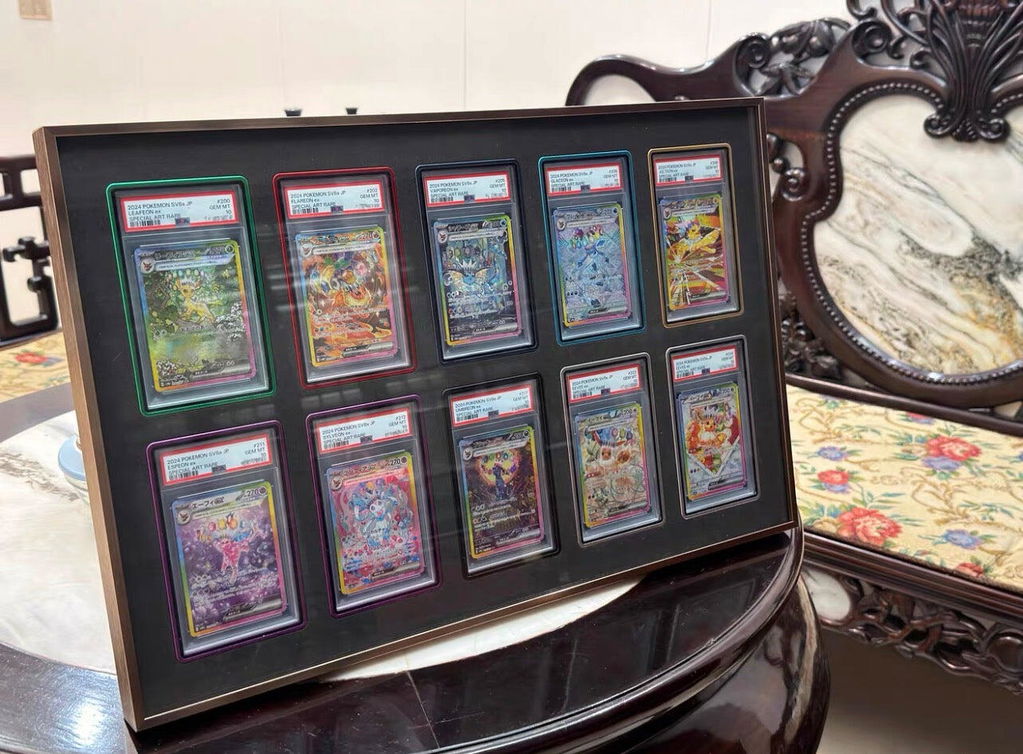
Acrylic UV Protection & Technical Specifications
Optical clarity, ultraviolet filtration, material properties and supplier test documentation for the glazing options used in our premium aluminium display frames.
At Card Collective Studio, we select our glazing with careful consideration for presentation quality, optical clarity and ultraviolet resistance. Every aluminium display frame includes Premium Clear Acrylic as standard, with the option to upgrade to PLEXIGLAS® Gallery & Museum Anti Reflective Acrylic.
This reference compares both materials using the information supplied by our Australian acrylic supplier, including product specifications, technical data sheets, material safety information and UV testing.
Acrylic Glazing Options at a Glance
Premium Clear Acrylic
Our Premium Clear Acrylic is a high-UV-resistance glazing material, not simply basic clear plastic. Our supplier rates its UV and weather resistance as Excellent (9/10 in its comparative technical data) and its optical clarity as Excellent (10/10). With up to 92% visible-light transmission, it delivers a clear, attractive display while providing strong inherent resistance to ultraviolet exposure. A separate supplier UV report provides further wavelength-specific information in the detailed section below.
PLEXIGLAS® Gallery & Museum Anti Reflective Acrylic
A clear cast acrylic sheet with anti-reflective treatment on both surfaces. The supplier lists approximately 99% light transmission, less than 1% combined surface reflectance and up to 99% UV blocking for wavelengths below approximately 400 nm.
Available in 2 mm and 3 mm thicknesses, with 3 mm offering increased rigidity for larger spans.
Technical Comparison
| Property | Premium Clear Acrylic | Gallery & Museum Acrylic |
|---|---|---|
| Material | PMMA acrylic sheet | Cast acrylic with dual-sided anti-reflective coating |
| Availability | Included | Optional upgrade |
| Visible-light transmission | Up to 92% | Approximately 99% |
| UV protection | Excellent UV resistance (supplier rating 9/10); UV report documents filtering of shorter wavelengths below approximately 330 nm | Up to 99% UV blocking below approximately 400 nm (supplier claim) |
| Surface reflectance | Not quantified in supplied documents | Less than 1% total, both surfaces combined |
| Anti-reflective coating | None specified | Both surfaces |
| Density | 1.19 g/cm³ | 1.19 g/cm³ |
| Refractive index | Not listed | Approximately 1.49 |
| Continuous service temperature | Approximately 80°C (product listing) | Approximately 80–90°C (product listing) |
| Weathering recommendation | Excellent weather resistance | Interior use recommended |
| Chemical care | Avoid solvents and alcohols | Avoid ammonia, alcohol and strong solvents |
| Flammability | Flammable; Class 3 listed | Combustible; UL94 HB typical for acrylic |
| Typical use | Everyday display glazing | Fine-art and museum glazing, picture framing and display applications |
Numerical values and qualitative ratings are supplier-reported. “Up to” is a maximum reported value, not a guaranteed minimum across every wavelength or installation.
1. Premium Clear Acrylic - Detailed Specifications
Premium Clear Acrylic is our standard high-UV-resistance glazing, made from clear polymethyl methacrylate (PMMA). The supplier specifically describes its UV resistance and weather resistance as Excellent, with a comparative UV/weather rating of 9/10. It combines these properties with excellent optical clarity, making it a strong material choice for our display frames even without the optional museum-grade upgrade.
Optical & physical properties
| Property | Supplier value |
|---|---|
| Light transmission, clear | Up to 92% |
| Optical clarity | Excellent; 10/10 comparative rating in generic technical sheet |
| Density | 1.19 g/cm³ |
| Tensile strength | Approximately 70 MPa |
| Flexural strength | Approximately 110 MPa |
| Charpy impact strength, unnotched | Approximately 17 kJ/m² |
| Water absorption, 24 hours | Approximately 0.3% |
| Maximum continuous service temperature | Approximately 80°C, product listing; generic technical sheet lists 70°C |
| Softening temperature | Approximately 105°C, product listing; supplied cast-acrylic SDS states >100°C |
| UV resistance | Excellent; 9/10 comparative rating in generic technical sheet |
| Weather resistance | Excellent |
| Chemical resistance | Good; avoid solvents and alcohols |
| Flammability | Class 3 listed; combustible PMMA |
| Typical material uses | Displays, signs, glazing, protective barriers |
UV resistance and supplier spectrophotometer report
Our supplier rates the material's UV and weather resistance as Excellent. Its separate “Acrylic Sheet & UV Absorbing” report provides further information on how cast acrylic interacts with ultraviolet wavelengths. The document identifies UV-C (200–290 nm), UV-B (290–315 nm) and UV-A (315–400 nm), and describes filtering of shorter UV wavelengths below approximately 330 nm.
The report includes a spectrophotometer graph on page 2 covering approximately 250–450 nm, titled “Digitised spectra of acrylic samples,” with its vertical axis labelled “% Absorbance.” The approximately 330 nm cutoff describes one aspect of the material's UV behaviour; it should not be interpreted as meaning the acrylic has poor UV resistance overall. The supplier's broader material rating remains Excellent.
The report does not supply one certified blocking percentage for every wavelength across the full UVA range. The museum-grade option is separately specified for enhanced UV blocking up to approximately 400 nm.
Supplier's comparative PMMA material ratings
| Characteristic | Rating |
|---|---|
| Optical clarity | 10/10 |
| UV/weather resistance | 9/10 |
| Machinability | 9/10 |
| Heat resistance | 5/10 |
| Impact resistance | 4/10 |
| Chemical resistance | 4/10 |
The technical data sheet identifies these as indicative comparative selection ratings, not guaranteed engineering measurements. Additional notes: medium weight class; mid-range cost tier; food-safe grade available; not weldable.
2. PLEXIGLAS® Gallery & Museum - Detailed Specifications
This supplier-listed premium acrylic combines high light transmission with a coating on both faces to reduce front- and rear-surface reflections. The supplier calls its cast product “Gallery UV100” and lists it in 2 mm and 3 mm sheet thicknesses.
Optical, UV & physical properties
| Property | Supplier value |
|---|---|
| Construction | Cast PMMA sheet with dual-sided anti-reflective coating |
| Light transmission | Approximately 99% |
| Total reflectance | Less than 1% across both coated surfaces combined |
| UV performance | Up to 99% UV blocking for wavelengths below approximately 400 nm |
| Density | 1.19 g/cm³ |
| Refractive index | Approximately 1.49 |
| Impact resistance | Approximately 10–17 times stronger than glass (supplier description; comparison method not supplied) |
| Continuous service temperature | Approximately 80–90°C (product listing) |
| Weather resistance | Interior use recommended |
| Chemical resistance | Avoid ammonia, alcohol and strong solvents |
| Flammability | Combustible; UL94 HB typical for acrylic |
| Available sheet thicknesses | 2 mm and 3 mm |
| Standard full-sheet formats listed | 2440 × 1220 mm and 3050 × 2030 mm |
| Applications | Museum glazing, fine-art and photographic framing, exhibitions, memorabilia and display cases |
Thickness & installation
The supplier describes 2 mm as suitable for smaller, lightweight installations and 3 mm as offering greater rigidity and suitability for larger frames and wider spans.
Important installation note from the supplier: The museum acrylic listing states that its anti-reflective grade is designed for prints or artwork positioned directly behind, in contact with or as close as possible to the sheet. It cautions that a gap can create a hazier or less sharp appearance, increasing with separation. Since graded trading cards sit behind the front glazing, viewing clarity in the assembled frame should be assessed before relying on the premium material's advertised optical benefits.
What the quoted UV specification means
“Up to 99% below approximately 400 nm” is the supplier's product-level UV claim. The provided documents do not include a wavelength-by-wavelength museum-grade transmission test or a graph proving a specific minimum percentage at each wavelength. The shared generic PMMA data sheet should not be mistaken for a specialist anti-reflective-coating test certificate.
3. Shared Acrylic Material & Safety Data
Both product listings link to the same generic PMMA technical data sheet and the same cast-acrylic material safety document. These describe characteristics of acrylic as a material, rather than separate tests of the museum-grade coating.
Generic PMMA technical data sheet - full comparative facts
| Characteristic | Document value |
|---|---|
| Material | Acrylic (PMMA); material code ACRYLIC |
| Impact resistance | 4/10 |
| Chemical resistance | 4/10 |
| UV/weather resistance | 9/10 |
| Heat resistance | 5/10 |
| Machinability | 9/10 |
| Optical clarity | 10/10 |
| Max service temperature | 70°C |
| Density | 1.19 g/cm³ |
| Weight class | Medium |
| Cost tier | Mid-range |
| Food-safe grade available | Yes |
| Weldable | No |
| Example applications | Displays, signage, sneeze guards, glazing |
The supplier explicitly calls these indicative relative ratings; grades, colours and thicknesses can vary.
Cast acrylic safety data - composition, handling & storage
The accompanying SDS identifies cast acrylic sheet manufactured by PT. Margacipta Wirasentosa. It describes a high-molecular-weight acrylic sheet, with methyl methacrylate content stated as greater than 90% and no classifiable hazardous ingredients listed.
| Item | Safety document information |
|---|---|
| Form | Solid sheet, clear or coloured |
| Density | 1.19 (as stated in SDS) |
| Softening point | Greater than 100°C |
| Decomposition | SDS states no decomposition below 200°C |
| Water solubility | Insoluble |
| Organic solvents | Soluble in many organic solvents including acetone and chlorinated hydrocarbons |
| Storage | Below 40°C; away from heat; sheet storage vertically on A-frames |
| Normal handling | Low toxicity reported; sharp chipped edges may cause injury |
| Processing | Laser cutting or heating may generate hazardous vapours; use proper ventilation and protective measures |
| Fire | Combustible; UL94 HB; DIN 4102 B2; BS 476 Part 7 Class 3 and other standards listed |
| Transport | Not classified as dangerous for transport |
| Supply/use | Not classified as dangerous for supply/use in the SDS |
| Environmental classification | Not classified as dangerous for the environment |
The SDS includes further first-aid, fire-fighting, personal protective equipment, disposal and occupational-processing instructions; consult the original document for industrial use. The SDS is not a material-specific UV or anti-reflective test.
4. Understanding UV Protection & Reflectance
Ultraviolet wavelength bands
The supplied UV document identifies UV-C as 200–290 nm, UV-B as 290–315 nm and UV-A as 315–400 nm. The distinction matters because blocking shorter UV wavelengths does not automatically establish the same performance at longer UVA wavelengths.
Transmission, absorption & reflection
Transmission refers to light passing through the glazing. Absorption refers to light energy taken up by the material. Reflection refers to light returned from the sheet surfaces, which can cause glare. These are different measurements and should not be treated interchangeably.
Displaying valuable collectibles
UV filtering is one component of responsible display conditions. Light intensity, duration, temperature and placement also matter. For sensitive cards and artwork, avoid direct sunlight and prolonged strong illumination regardless of glazing choice.
5. Supplier Documents & Test Reports
Our acrylic specifications draw on technical information supplied by our Australian material supplier, including its PMMA technical data sheet, cast-acrylic safety data sheet, Premium Clear Acrylic UV report and Gallery & Museum acrylic product specifications.
The Premium Clear Acrylic UV report includes spectrophotometer data illustrating the material's response across approximately 250–450 nm. For museum-grade acrylic, the published optical and UV performance figures are the supplier's product specifications. The generic PMMA technical and safety sheets describe the base material and should not be confused with a separate test of the museum-grade anti-reflective coating.
We publish supplier-reported values as received. Where source materials specify different general service-temperature values, both are identified above rather than silently combined. Specifications may change by grade, thickness and supplier updates.
6. Frequently Asked Questions
What acrylic is included with every frame?
Premium Clear Acrylic is included as standard and is rated by our supplier as having Excellent UV resistance and Excellent weather resistance, alongside up to 92% visible-light transmission. It is a high-quality, UV-resistant display glazing material without any upgrade required.
What does the museum-grade upgrade change?
The supplier advertises approximately 99% light transmission, under 1% combined surface reflectance and up to 99% UV blocking below about 400 nm. Its dual-sided anti-reflective coating is the key distinction.
How UV resistant is the included Premium Clear Acrylic?
The supplier rates our standard acrylic as having Excellent UV resistance. Its UV spectrophotometer report describes filtering below approximately 330 nm, but does not specify 99% blocking across the full UV range. The museum-grade option is separately advertised for up to 99% UV blocking below approximately 400 nm.
Does museum-grade acrylic guarantee that cards will never fade?
No glazing material prevents every form of light-related deterioration. Control exposure time, light intensity and direct sun in addition to choosing suitable glazing.
Can I clean the acrylic with household glass cleaner?
Avoid ammonia, alcohol and aggressive solvents, especially on anti-reflective surfaces. Follow the product manufacturer's approved cleaning method and use a clean, soft cloth.