


Pokémon cards are collected for their artwork as much as their rarity. A favourite holographic card, a Japanese promo or an entire graded evolution line can look exceptional on a wall. But displaying them introduces a question every serious collector should understand: does sunlight fade Pokémon cards?
Yes, prolonged light exposure can contribute to fading and other material changes. Ultraviolet radiation is part of the concern, but so are visible light, temperature and exposure time. A PSA graded slab, One Touch magnetic holder or acrylic display frame can change the protection around the card without making sunlight irrelevant.
This guide explains Pokémon card UV damage and practical display decisions for raw, sleeved and graded collections. For a broader technical explanation of acrylic, glass and wavelength filtration across all trading card games, see our complete UV protection guide for trading card display frames.
Can Pokémon cards really fade in sunlight?
Yes. Printed materials can change when exposed to light over time, and trading cards are no exception. The exact rate depends on inks, dyes, coatings, printing processes and the amount of light received.
Sunlight is an especially demanding light source because it is intense, contains ultraviolet radiation and can raise temperatures around a display. The Library of Congress explains how UV exposure can cause colours to fade through photodegradation, while visible light and solar heat can also contribute.
There is no universal rule that every Pokémon card will visibly fade after a particular number of days, months or years. Different cards and display environments behave differently.
What happens to a Pokémon card when light causes fading?
Light-driven chemical changes can alter printed colours, reduce contrast or change the appearance of inks and coatings. Some materials may yellow or discolour rather than simply become lighter.
These changes are not always obvious immediately. A card may be exposed repeatedly before a collector notices a difference. Once colour has changed chemically, moving the card into dark storage does not return it to its original printed state.
For important Pokémon cards, it is sensible to avoid using direct sunlight as a display light source.
Are holographic Pokémon cards more vulnerable to UV?
A holographic card combines reflective effects with printed artwork and other surface layers. Those components may have different responses to light, but it would be inaccurate to claim every holographic Pokémon card fades faster than every non-holographic card.
The foil finish can also make visual changes harder to assess because the card's appearance varies with viewing angle. A different reflection is not necessarily evidence of fading.
For a holographic display, controlled lighting and a clear viewing angle are valuable both for presentation and for managing unnecessary exposure.
Full-art, textured, vintage and Japanese Pokémon cards
Pokémon collections include cards from many years, printers, regions and production methods. Vintage holo cards, modern full-art and special illustration cards, Japanese promos and textured finishes should not all be assumed to share one identical light-sensitivity profile.
Collectors may reasonably take a more conservative approach with valuable vintage cards or rare promos, especially when replacement is difficult. That does not require treating newer cards carelessly; it simply recognises that the collection's importance can shape display decisions.
UVA, UVB and what reaches a Pokémon display
Ultraviolet radiation is described by wavelength. UVC from natural sunlight is effectively screened out by the atmosphere. UVB is reduced substantially before reaching many indoor environments. UVA, extending towards 400 nanometres, remains important when comparing glazing materials and daylight exposure.
Different acrylic sheets filter different parts of this spectrum. A product that reduces short UV wavelengths is not automatically equivalent to specialist conservation acrylic filtering much closer to 400 nm.
For a Pokémon wall display, the important question is which material is actually in front of the card and what its manufacturer has documented.
Does sunlight through a window fade Pokémon cards?
It can. A window filters some incoming ultraviolet light but still admits visible daylight, and some UV wavelengths can remain. Direct sun through a window can be far brighter than typical room lighting.
Do not judge a wall only at one time of day. A display may be shaded in the morning and receive a direct beam in late afternoon. The angle of sunlight also changes through the seasons.
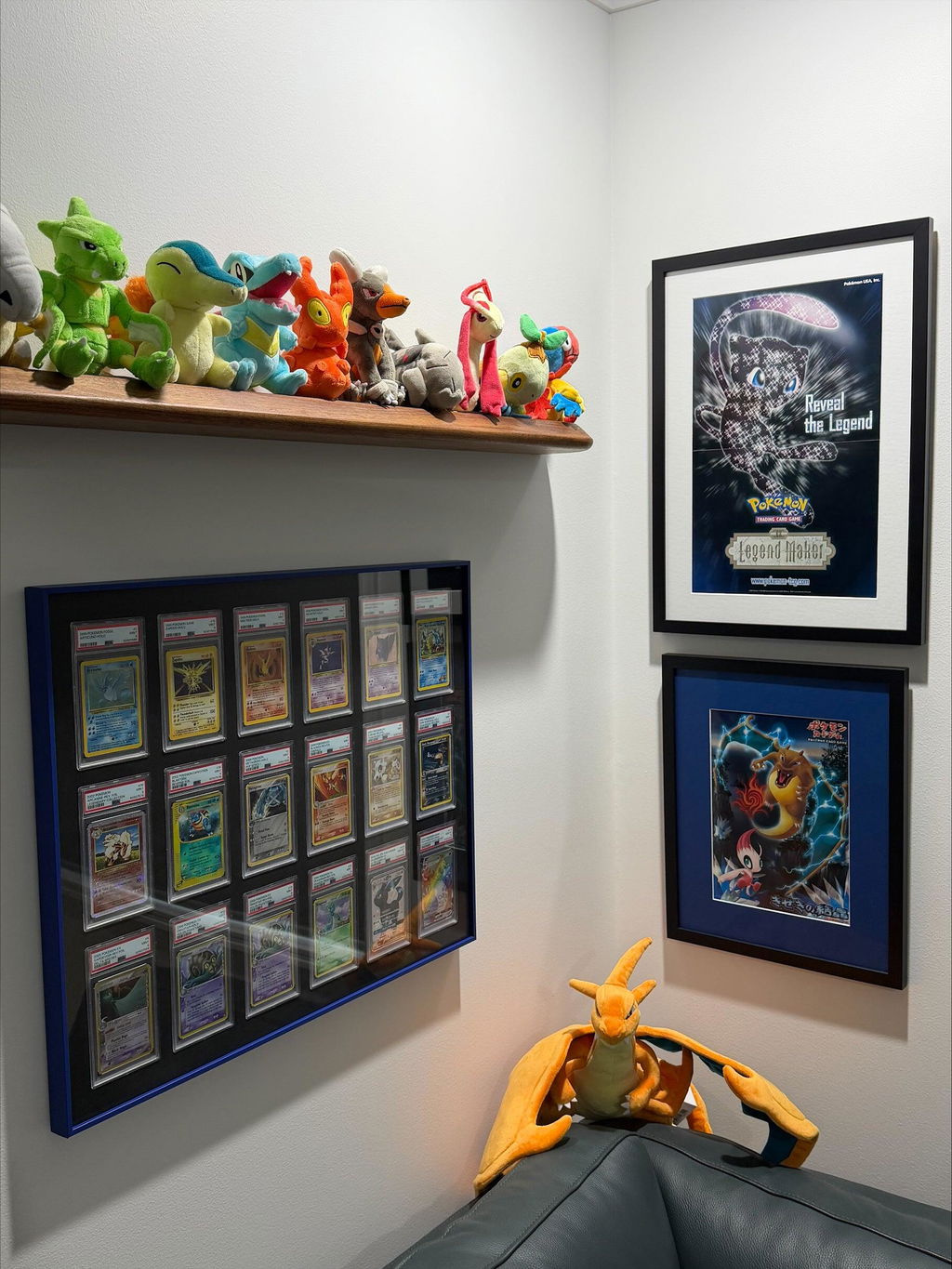
An interior wall outside regular direct sunlight is generally a more controlled location for a valuable Pokémon card display.
Can a Pokémon card fade while inside a PSA slab?
Yes, encapsulation does not eliminate every possible form of light-related change. PSA itself recognises sunlight fading as a potential condition change in a card submitted for reholder service.
PSA introduced an updated standard trading card holder in 2024 and described its polymer as more resistant to UV damage from the sun. That manufacturer statement is useful, but it should not be converted into a universal 99% or 100% UV-blocking claim for every PSA slab generation.
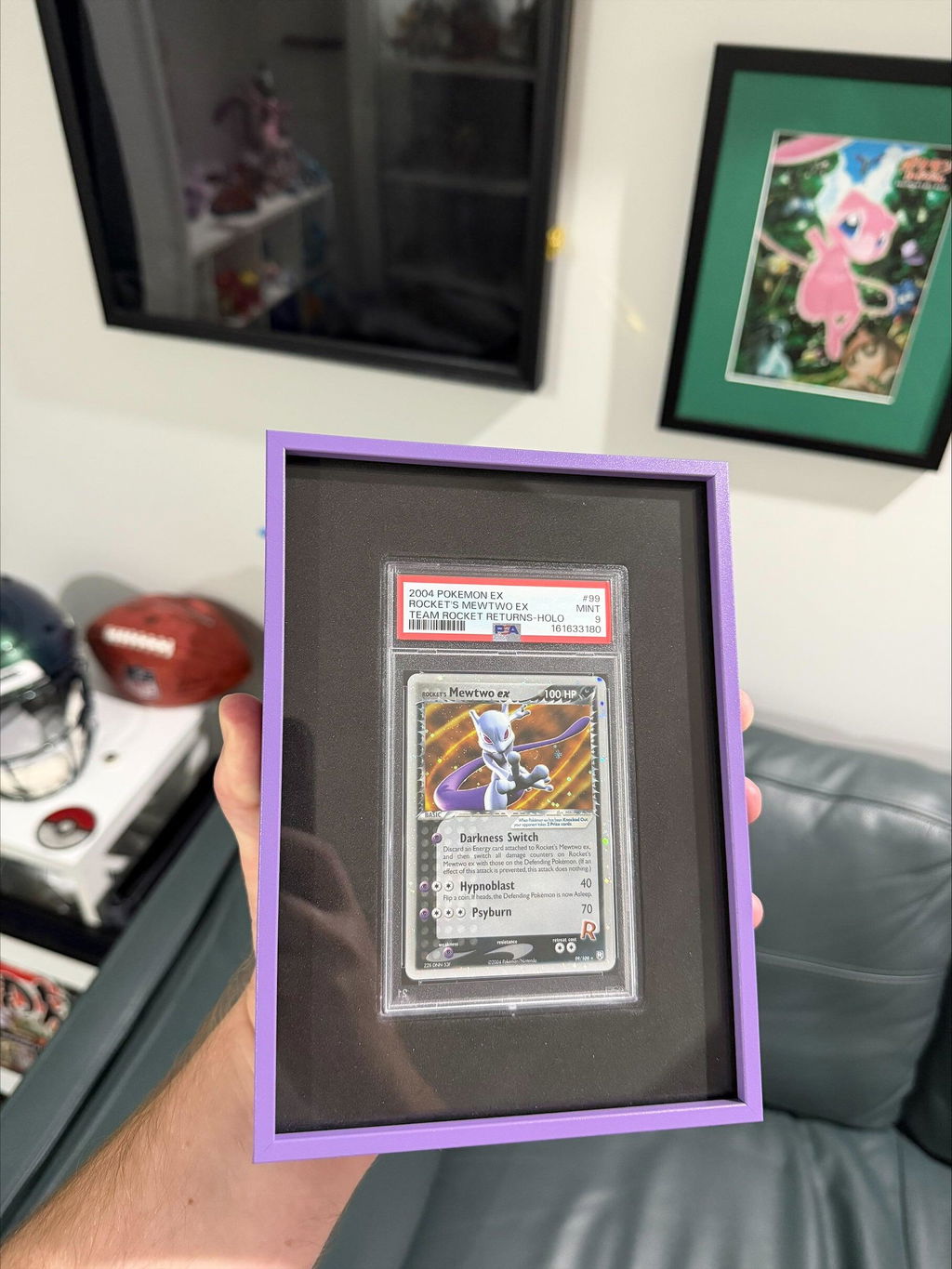
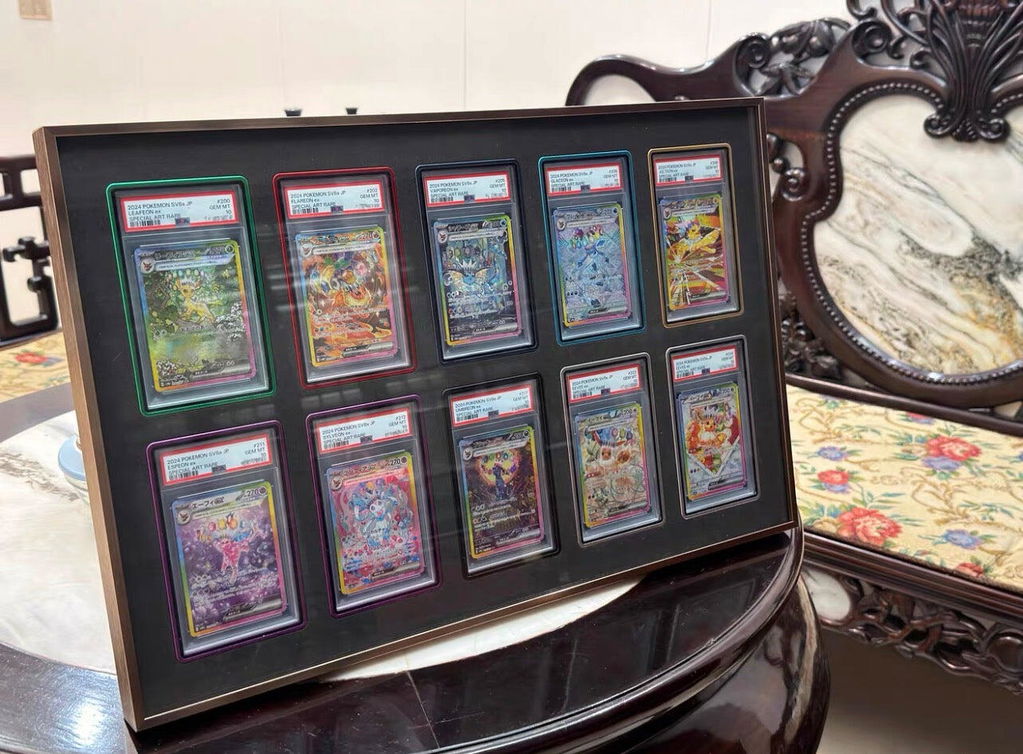
A PSA 10 Charizard, graded Pikachu promo or any other valuable Pokémon card can still benefit from sensible wall placement and separately specified frame glazing. For holder-specific detail, see Are PSA, BGS & CGC Graded Slabs UV Protected?.
What about CGC and BGS Pokémon slabs?
CGC and Beckett Grading Services (BGS) also encapsulate Pokémon cards in rigid holders. The holder provides physical protection and professional presentation, but a grading company's name or label is not a universal UV percentage.
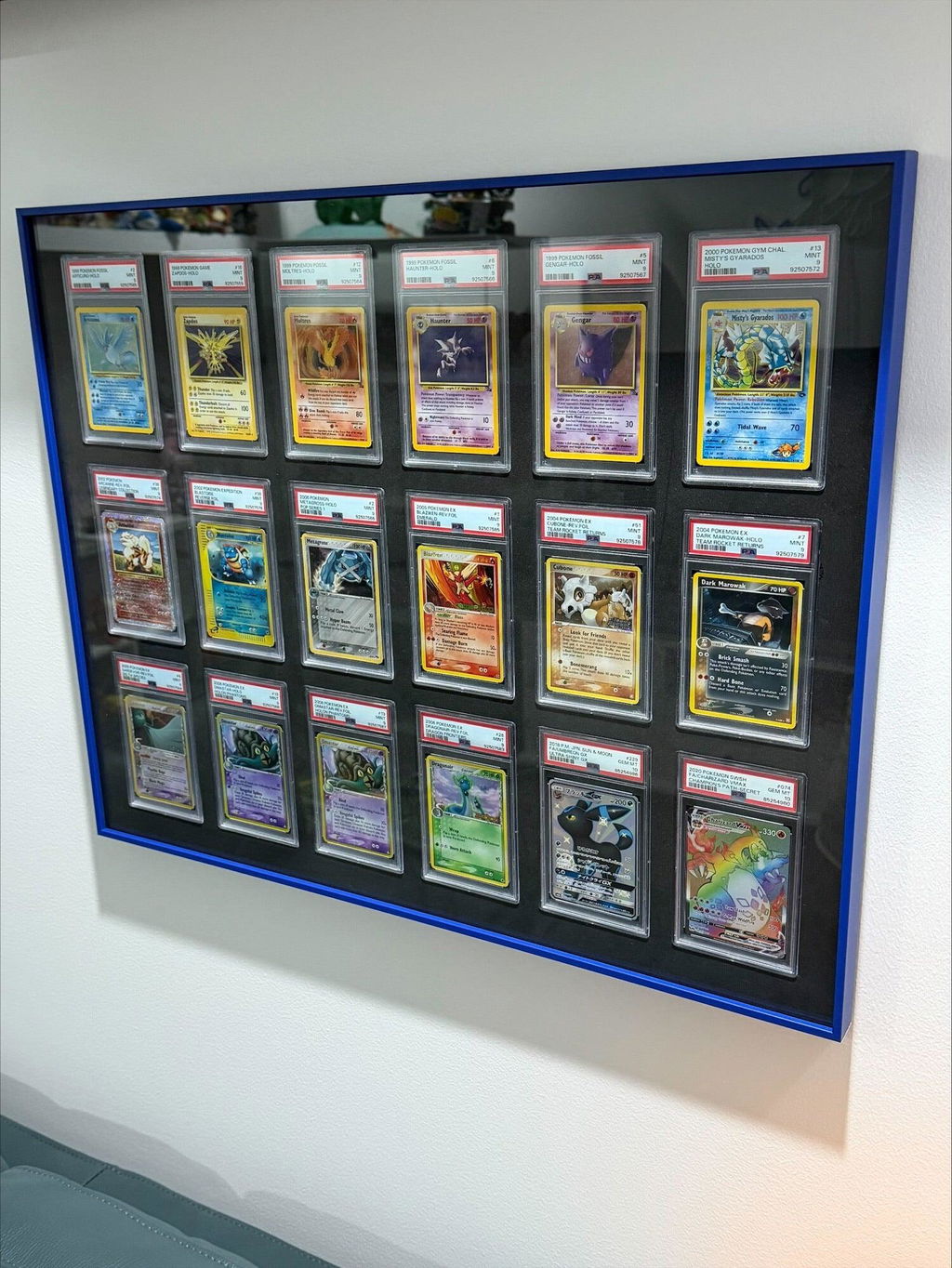
For a mixed PSA, CGC and BGS display, the external acrylic or glass panel can have its own documented UV filtration regardless of which slab sits behind it.
Do One Touch magnetic holders protect Pokémon cards from UV?
Some One Touch magnetic holders are sold with UV-blocking materials. Ultra PRO, for example, describes UV-blocking additives in parts of its ONE-TOUCH range.
That is useful protection to consider when displaying an ungraded Pokémon card, but check the specific product model and do not assume all magnetic holders use the same material.
The holder can be combined with an outer display frame that has UV-resistant acrylic or glass. Our One Touch UV protection guide covers this arrangement in more detail.
Are penny sleeves and top loaders enough for sunlight?
A sleeve or top loader reduces handling contact and can help keep a raw Pokémon card supported. Neither accessory should be assumed to provide specialist ultraviolet filtration unless the manufacturer supplies that specification.
For wall displays using sleeved or top-loaded cards, the outer glazing may be the clearest documented UV-filtering layer. The frame should also support the cards without adhesive contact or excessive pressure.
UV-resistant acrylic for Pokémon card display frames
Acrylic is popular because it is clear, relatively lightweight and suitable for both small and large frames. Different formulations offer different UV-filtering properties.
When comparing products, look beyond the phrase “UV resistant.” Check the specified wavelength range, transmission information and actual sheet grade. If a material is described as filtering wavelengths below approximately 330 nm, that is different from a specialist product designed to reduce UV closer to 400 nm.
The aim is to understand the glazing used in the specific Pokémon display frame rather than assume all transparent acrylic performs identically.
Acrylic versus glass for displaying Pokémon cards
Both can be good options. Acrylic is lighter and generally more impact-resistant than ordinary glass, which matters for large PSA or CGC graded slab displays. Glass is typically harder and more resistant to everyday scratches.
Specialist UV-filtering and anti-reflective grades are available in both categories. The best choice depends on the frame size, location, visual finish and product specifications.
Our acrylic versus glass trading card display guide compares those properties in depth.
Does 99% UV protection prevent Pokémon cards fading?
A documented 99% UV reduction can be an excellent feature of specialist glazing, but the percentage needs to be understood within its measured wavelength range.
Visible light can also contribute to fading, and intense sunlight may introduce heat. High UV filtration should therefore be viewed as part of a thoughtful display setup, not a promise that a Pokémon card can never change.
Even with museum-grade acrylic or glass, reducing unnecessary direct sunlight remains a sensible choice.
Can LED lights fade Pokémon cards?
Many ordinary white LEDs emit relatively little UV, but they still produce visible light. Exposure intensity and duration therefore matter when illuminating a Pokémon collection.
LED strips can create appealing highlights across holographic and textured cards, but they can also reflect on the outer acrylic and PSA slab surfaces. A softer, diffused arrangement is often easier to view than an intense exposed strip.
For the lighting-specific questions, see Do LED Lights Fade Trading Cards?.
How to choose a wall for a Pokémon card display
- Observe the wall in morning and afternoon sunlight.
- Avoid a position that receives regular direct sun through a window.
- Consider the card holders: raw, sleeved, One Touch, PSA, BGS or CGC.
- Choose acrylic or glass with a clear UV-filtration specification.
- Test reflections from windows and room lights through the final glazing.
- Keep lighting moderate and avoid unnecessary heat.
- Allow the display to be opened so the collection can change over time.
How to display a Pokémon collection without hiding it away
Collectors do not have to choose between enjoying artwork and making sensible preservation decisions. A wall outside direct sunlight, quality glazing and controlled lighting can create a strong display without subjecting the cards to avoidable exposure.
A single featured card may suit a compact frame. An evolution line, Japanese promo set or large graded collection may use a multi-grid wall display. In each case, protection choices should follow the actual holder, room and desired presentation.
For broader layout and construction ideas, see our guide to making a Pokémon trading card wall display.
Does the same advice apply to other TCGs?
Yes. Yu-Gi-Oh!, Magic: The Gathering (MTG), One Piece, Disney Lorcana, Digimon and sports cards involve printed materials that can be affected by light. The specific inks, coatings and finishes differ, but the general principles of UV filtration, visible-light exposure and sensible display placement apply.
There is no reason to invent separate universal fading timelines for each trading card game. Actual manufacturing and environmental conditions matter more than the name of the TCG.
Signs that a displayed card may have changed
Possible signs include altered colour balance, reduced contrast or changes to previously consistent printed areas. But lighting angle, camera settings, foil reflections and differences between print runs can also change how a Pokémon card appears.
If condition matters, compare it under consistent neutral lighting and avoid drawing conclusions from photographs taken with different cameras or exposure settings.
A visual comparison may raise a concern, but it is not a substitute for controlled material analysis.
Common Pokémon display myths
- A PSA 10 grade prevents fading. Grading and light protection are different considerations.
- All acrylic blocks the same UV wavelengths. Formulations and specifications vary.
- Window glass removes every fading risk. Visible light remains and some UV can pass.
- Every holographic card fades at the same rate. Materials and exposures differ.
- LED lighting produces no meaningful exposure. Visible light and duration still matter.
- Museum-grade glazing makes direct sun ideal. Strong sunlight should still be managed.
Frequently asked questions
Will direct sunlight ruin a Pokémon card?
Prolonged direct sunlight can contribute to fading and other damage. The rate depends on the card and exposure, so avoiding it is sensible.
Can a PSA 10 Pokémon card fade?
Yes. A grading score does not make an encapsulated card immune to future light-driven changes.
Does UV-resistant acrylic protect Pokémon cards?
It can reduce specified ultraviolet wavelengths. Read the product's actual filtration data and continue to manage visible light and sunlight.
Will Pokémon cards fade through a window?
They can. Window glass filters some UV, but visible daylight and portions of the UVA range may still reach the display.
Do holographic Pokémon cards fade faster?
There is no universal ranking for every holographic versus non-holographic card. Printing materials and exposure conditions differ.
Are One Touch holders enough for a Pokémon wall display?
They offer rigid protection, and certain products advertise UV-blocking additives. Wall placement and any outer glazing still matter.
Is museum glass necessary for expensive Pokémon cards?
It is a specialist option rather than a universal requirement. The material specification, room and collector's preferences should guide the choice.
Can faded Pokémon card colours come back?
Light-driven chemical fading is not reversed simply by storing the card in darkness.
Final thoughts
Pokémon cards can be displayed beautifully while their light exposure is managed thoughtfully. The most useful decisions are to avoid regular direct sunlight, understand the UV properties of the holder and glazing, and control the brightness and duration of display lighting.
Whether the collection contains raw cards, One Touch magnetic cases or PSA, BGS and CGC graded slabs, a considered frame and wall location can help preserve the viewing experience without removing the collection from sight.
Continue Exploring
Continue with these guides to Pokémon display planning, UV protection and trading card framing.
📚 Collector Guides
-
UV Protection for Trading Card Display Frames
A full guide to acrylic, glass and UV filtration for trading card collections. -
How to Make a Pokémon Trading Card Wall Display
Explore holders, layouts, inserts, frames and display construction. -
How to Choose the Best Display Frame for Pokémon Cards
Compare frame styles, materials and practical options for Pokémon collectors.
🛒 Shop Display Collections
-
PSA, CGC & BGS Graded Slab Wall Display Frames
Display frames for graded Pokémon and other trading card collections. -
One Touch Wall Display Frames
Display frames designed around magnetic trading card holders.

0 comments